Cybersecurity Governance Explained: Frameworks, Roles, and Best Practices
Cybersecurity has moved from the server room to the boardroom, and leaders now face a question that shapes every investment, who decides how security is funded, measured, and led? Boards are already acting on it. According to WTW’s Directors’ and Officers’ Liability Survey 2026, 70% of organizations now formally integrate cyber risk into their board-level enterprise risk framework.
Cybersecurity governance provides the structure behind those decisions. This blog explains what it is, how it differs from daily security management, how AI is reshaping it, and how professionals can build the skills to lead it.
What is Cybersecurity Governance?
Cybersecurity governance is the set of policies, roles, and governance that ensures the security is aligned to the business objectives and establishes decision-makers and responsible parties. It addresses real-world issues such as which objectives to preserve first, how much to invest, and how to gauge progress.
It is not the same as cybersecurity management, where it's executed through the use of tools, control and everyday operations. Governance defines the direction and management delivers the results which inform the leaders of the way to go.
Why Does Cybersecurity Governance Matter for Modern Organizations?
Leaders want proof that security investment delivers value, and governance provides it through a shared language and consistent reporting. Its benefits reach beyond the security team:
- Business alignment: Every investment links to a business objective.
- Informed leadership: Executives see clear metrics instead of technical detail.
- Trust: Documented oversight shows that protection is a priority.
- Compliance readiness:Policies and evidence are organized in advance.
- Faster recovery: Defined roles shorten the path from incident to response.
Core Components of Cybersecurity Governance
The establishment of successful governance programs requires fitting a combination of strategy, policy, accountability, compliance and measurement into the governance framework.
All these components help the executive leadership with decision making and evaluation of results of the governance program.
- Strategy is about linking security goals to business objectives.
- Policies and standards allow for alignment of expectations across different teams in the organization.
- Roles and accountability refers to making the ownership of decisions clear.
- Compliance refers to the alignment of organizational practices with laws and contracts.
- Measurement includes allowing reporting on the progress made to the leadership.
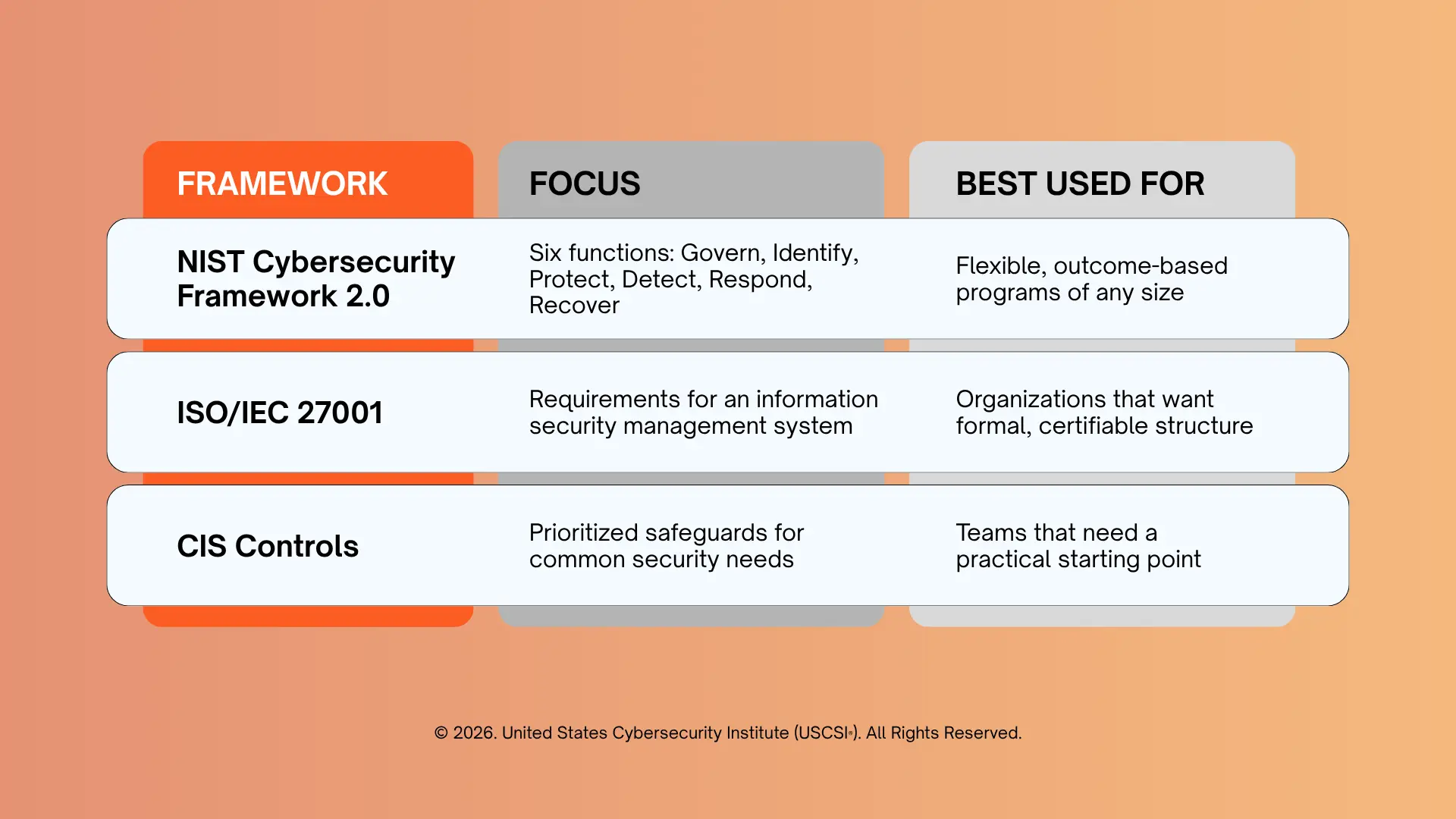
Established cybersecurity governance frameworks give these components structure, and most organizations choose one as a foundation, then adapt it to their size and industry.
Who is Responsible for Cybersecurity Governance?
Responsibility is shared, and each group contributes a distinct strength.
- The board sets expectations and oversees performance.
- The CEO and executives fund priorities and embed security in strategy.
- The CISO turns strategy into a program and reports results.
- Business unit leaders own security within their functions.
To see how leading voices approach security leadership, explore our top 8 global cybersecurity influencers to learn from in 2027.
Role of AI in Changing Cybersecurity Governance
AI adds new assets, decisions, and responsibilities that governance must cover. Teams use AI for detection and analysis, and organizations deploy AI agents that act on their own, so policies need to define approved uses, human oversight, and ownership of outcomes.
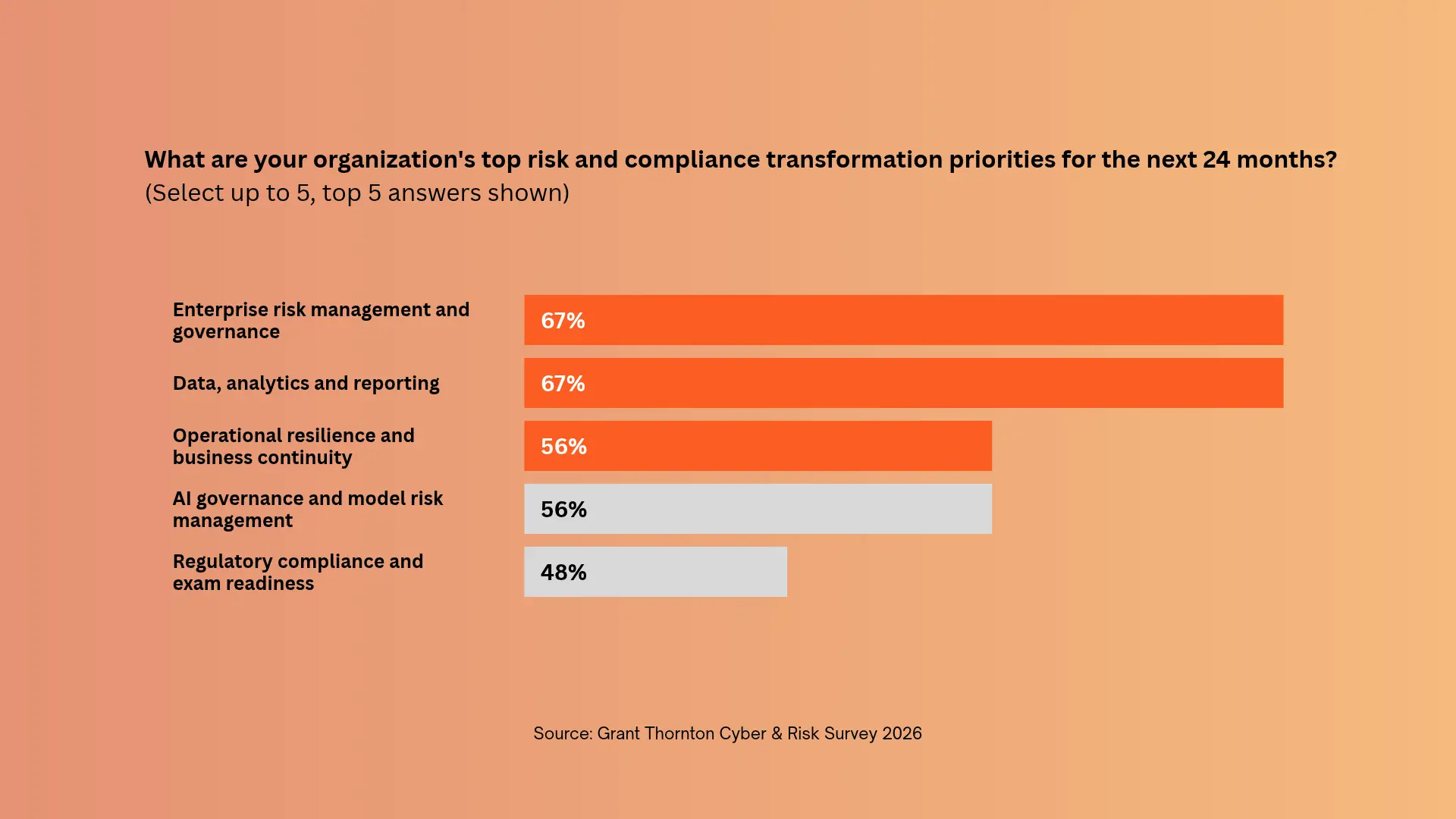
Leaders are already responding, in the Grant Thornton Cyber & Risk Survey 2026 of 1,100 business leaders, enterprise risk management and governance (67%) and AI governance and model risk management (56%) both rank among the top five transformation priorities for the next 24 months.
Brian Blakley, CISO at Bellini Capital and ConnectSecure, captures the central principle
“Organizations can delegate authority to an AI agent, but they can’t delegate accountability.”
AI also strengthens governance itself by supporting faster monitoring, reporting, and policy checks, provided teams validate its outputs. Governance programs respond with three steps.
- Maintain an inventory of AI systems and their owners.
- Set human review points for high-impact actions.
- Test how quickly teams can pause an AI system when needed.
Best Practices to Build an Effective Governance Program
Most programs begin with an honest look at what already exists: the policies on file, who owns which decision, and how well current controls match business priorities. That baseline shows where to focus first.
From there,the work follows a natural order:
- Link security strategy to business goals, so every priority has an owner and a purpose.
- Set decision rights and escalation paths. When an issue arises, people should know who decides and who is informed.
- Choose a framework and document policies that teams can follow with confidence.
- Share a short set of outcome-focused metrics with leadership every quarter.
- Revisit the program each cycle as technology and regulations change.
How Can Professionals Upskill for Governance Roles?
Governance roles reward professionals who combine security knowledge, regulatory awareness, and cybersecurity professional skills, and who can explain technical decisions in business terms. Several practical paths build these strengths:
- Study a framework in depth: Work through one governance framework from start to finish, and map its functions to a real organization.
- Practice board-level communication: Translate technical updates into short, outcome-focused briefings.
- Gain cross-functional experience: Collaborate with legal, finance, and compliance teams to see how security decisions connect to business priorities.
- Build AI governance literacy: Learn how AI systems are inventoried, reviewed, and overseen in your organization.
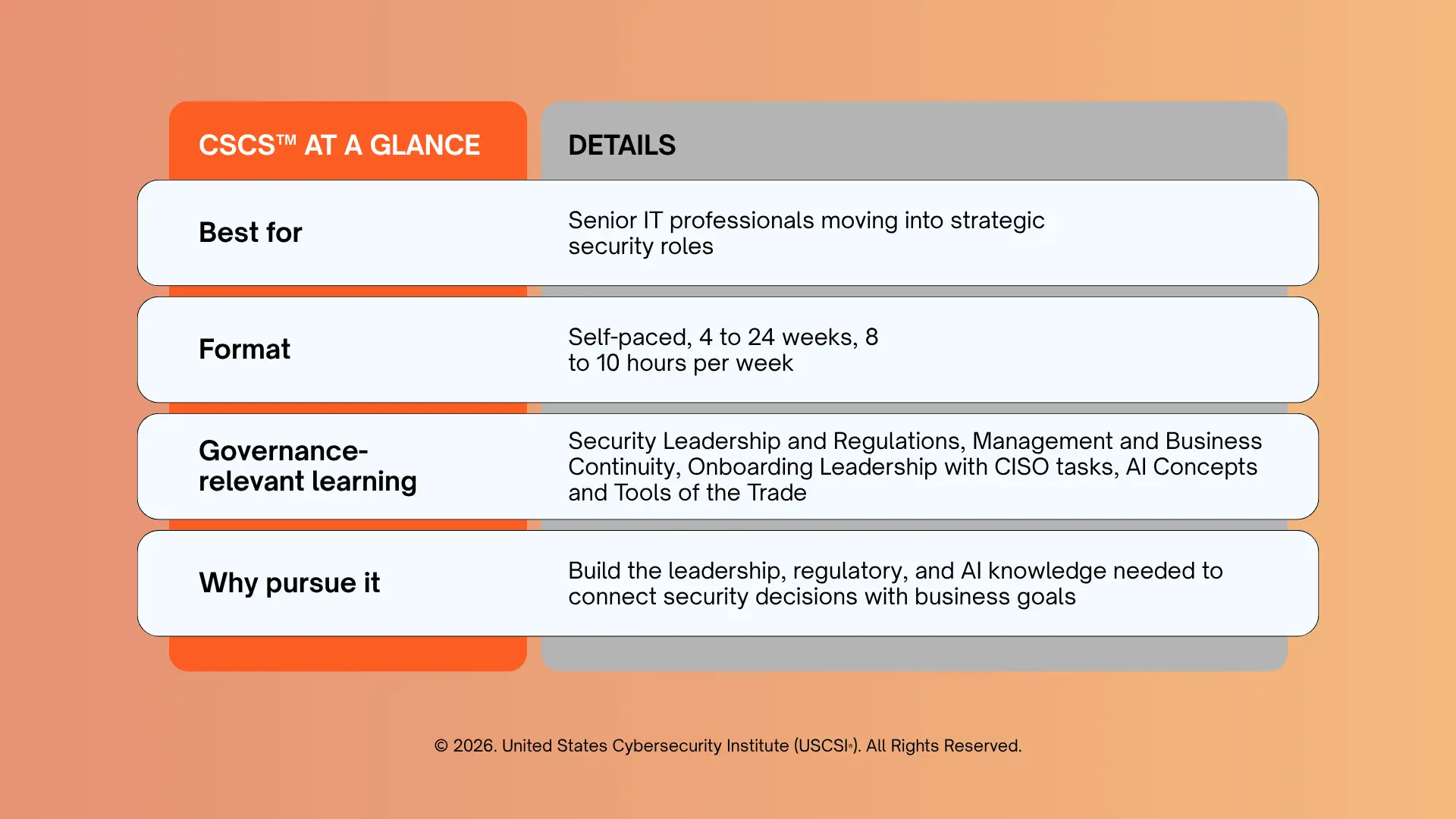
A structured cybersecurity certification adds depth and recognition to this experience. USCSI® supports that path with the Certified Senior Cybersecurity Specialist (CSCS™), outlined below.
Read more: Explore current and forecasted salaries, in-demand skills, and role trends in the USCSI® Cybersecurity Salary Factsheet 2027.
Governing What Comes Next
Security tools will keep evolving, and governance gives organizations the direction to evolve with them. With AI widening the scope of oversight, clear ownership and accountability will define the organizations that lead.
In 2027, expect governance to become more continuous, with live reporting replacing periodic reviews. Boards will ask sharper questions about AI use, and CISOs will increasingly act as strategic partners to the business. Professionals who pair security expertise with business insight will be central to that future.
FAQs
How often should a governance program be reviewed?
At least once a year, and after major changes in technology, regulation, or strategy.
Which metrics should security leaders report to the board?
Outcome-focused indicators work best, such as incident response time, control coverage for critical assets, and progress against agreed priorities.
How does quantum computing affect governance planning?
Programs are beginning to inventory where encryption is used so teams can plan a smooth move to post-quantum cryptography standards.