Physical AI Security: Key Risks and How to Address Them
The term physical AI refers to technologies that involve actions in the real world and are not limited to being used on screen. Technologies implementing physical AI capabilities began to be used not only in factories and warehouses but also in humanoid robots.
The Physical AI report of the Capgemini Research Institute compiled from interviews with 1,678 high-ranking executives from 15 industries points out that 67% of the respondents believe that physical AI is a true game-changer in their business area, although the report itself also indicates that as physical AI expands, it also becomes more liable to cybersecurity issues.
The transition from software-based security to physical security brings with it a new category of threats where the systems attacked do not only leak information but also may move, interact with surrounding objects, and communicate with people.
Why Physical AI Security is Different From Standard Cybersecurity
A handful of factors separate this category from conventional software security:
- A compromised server can leak data; a compromised robot or industrial system can cause direct physical harm.
- These systems consist of cameras, microphones, sensors, and actuators in one endpoint, providing attackers with much more surface area than a traditional server.
- The robotic communication middleware layer, typically the Robot Operating System (ROS2), creates its own unique attack surface that is not typically seen in a traditional IT environment.
- Detection requires being able to observe physical behavior, not only digital logs because a system that has been compromised can appear to be functioning without any alterations or only subtle ones executed.
Key Physical AI Security Threats
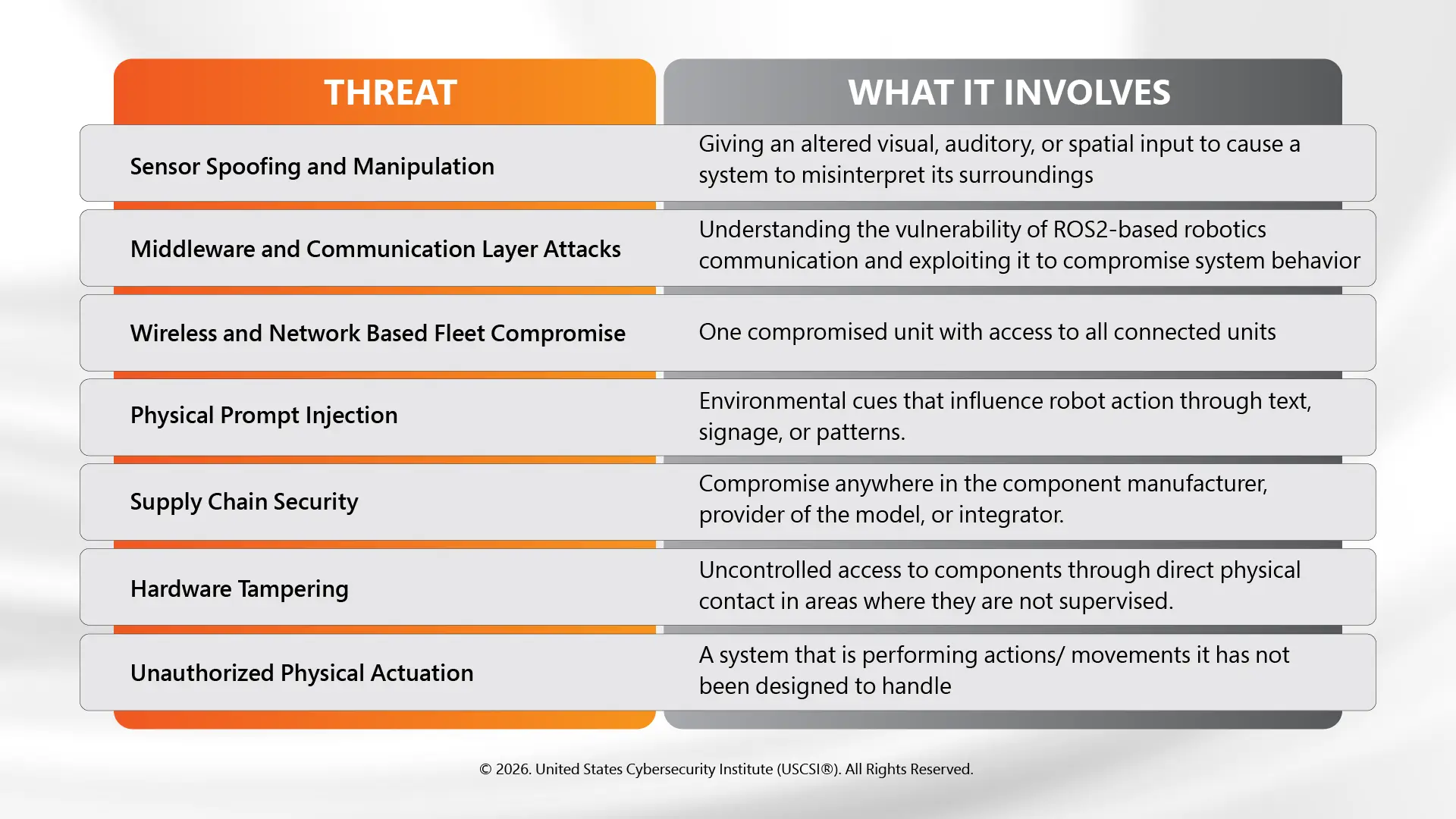
These seven threat categories represent the most common ways physical AI systems get compromised today, spanning everything from manipulated sensor input to unauthorized physical movement. Each one requires a distinct defense, which the mitigation strategies in the next section address directly.
How to Mitigate Physical AI Security Risks
Each threat above has a corresponding defense built specifically to address it. The six practices for Physical AI risk management below map directly onto the risks identified in the table.
- Secure the Communication Layer
Considering how broadly ROS2 and other similar middleware technologies are being used, conducting vulnerability patching and adopting secure versions such as SROS2 resolves one of the more easily exploitable shortcomings in the infrastructure for physical AI.
- Validate Sensor Input Redundantly
Having to check sensor data against more than one source, instead of just one feed, makes it much harder to spoof undetected.
- Segment Networks Across the Fleet
Restricting the scope of a compromised unit prevents a single exploited vulnerability from turning into an incident across the fleet.
- Verify Supply Chain Provenance
Auditing hardware components and the provenance of models before deployment closes the gap that tampering and compromised components further up the pipeline exploit.
- Enforce Physical Access Controls
Limiting physical access to a deployed unit is just as important as limiting digital access control, especially for systems that operate in less-monitored environments.
- Monitor Behavior Continuously
Rather than depending on access logs alone, looking for actions that are out of the ordinary catches the kind of subtle manipulation that purely digital monitoring tends to miss.
The Humanoid Robot Dimension
Humanoid robots are gathering all the risks mentioned in one place since the platform is sensor-based, networked, and capable of acting physically and is being used more frequently in the areas with human presence.
The developments in robotics, including Google DeepMind's Robotics Transformer 2, the open-source project OpenVLA, Omniverse and Isaac Sim from NVIDIA, and π₀ general-purpose robot by Physical Intelligence, are accelerating the process and making it essential to think of security only once these advancements are deployed in reality.
USAII's Humanoid Robots: The Next Physical AI Revolution looks closer at where this technology is actually headed, and understanding that trajectory is what makes the security considerations above worth planning for now rather than after deployment.
Building Security Skills for the Physical AI Era
Securing these systems requires cybersecurity expertise beyond standard IT training, covering network defense, incident response, and governance applied to systems that act in the physical world. USCSI's cybersecurity certifications CSCS™ build this kind of senior-level capability, covering governance, risk and compliance, incident response, threat intelligence, and network defense, giving professionals a structured path into securing physical AI.
What This Means for Organizations Deploying Physical AI Now
As physical AI technologies are now in the process of being put into real-world use, the idea of implementing physical AI security is not something that people can afford to think of for the future.
Businesses require methods that specifically address the subjects of middleware loopholes, sensor control, and overcoming an entire fleet, instead of a simple modified version of regular IT protection.
Building this expertise deliberately, before an incident forces the issue, is what separates organizations that scale physical AI safely from those that treat security as an afterthought.
FAQs
Can traditional cybersecurity tools detect physical AI security threats effectively?
Not entirely; traditional tools catch digital anomalies well but generally lack the sensor-level and behavioral monitoring needed to detect physical-world manipulation.
What is the future of Physical AI cybersecurity?
It's likely to increasingly overlap with AI security, OT security, robotics safety, and supply-chain security as these systems grow more connected.
Who typically owns physical AI security within an organization, IT or operations?
This varies and is often a gap; the most effective organizations build shared ownership between IT and operations rather than leaving it to one side.