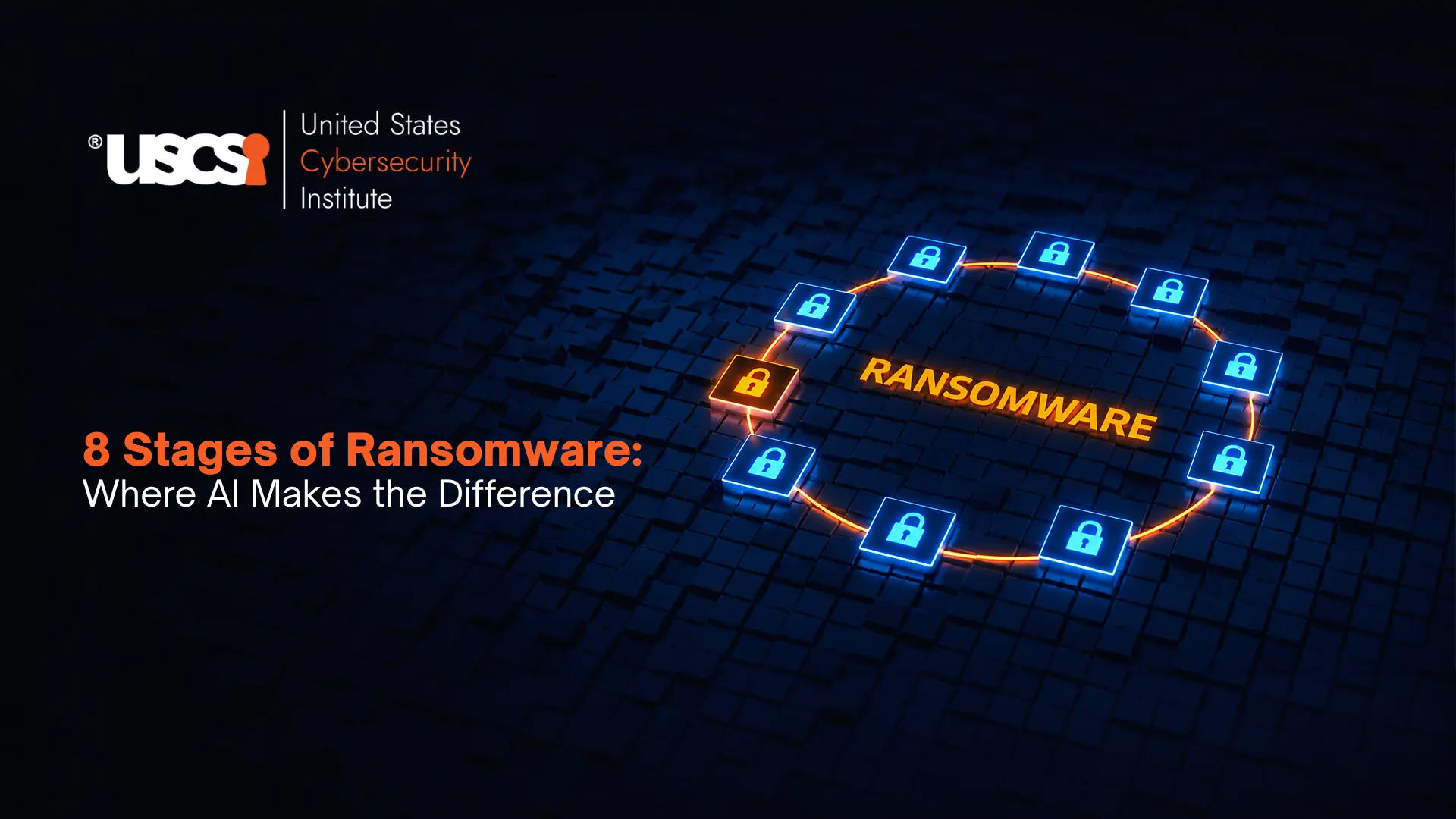
Understanding 8 Ransomware Attack Stages and AI-Powered Defense
Ransomware locks an organization out of its own systems or data, typically through encryption, then demands payment for the keys back. Attackers have added a second lever in recent years that either pay, or the stolen data goes public.
Ransomware reached 39% of breached organizations in 2026, up from 34% the year before, according to IBM's 2026 Cost of a Data Breach Report. AI is helping attackers run these campaigns faster and at greater scale, and 41% of ransomware incidents now lean on reputational pressure rather than encryption alone.
How Ransomware Actually Unfolds
An attack rarely looks like a single dramatic moment. Attackers often remain inside a network for days or weeks before triggering encryption. Most of what they do resembles routine administrative work. Data theft usually happens quietly, long before anything gets locked. Older tools check activity against blocklists and known signatures, not behavior, and attackers have gotten good at working around exactly that.
AI-driven detection asks a different question, not whether an action matches something already known to be bad, but whether it fits the normal pattern for a given user, device, or network segment. That shift is what lets it catch something it has never encountered before. Let us discuss in detail the 8 stages of ransomware attacks.
Stage 1: Reconnaissance and Target Profiling
Before disrupting anything, attackers research their target: scanning for exposed services, identifying unpatched systems, or profiling employees who might be easy social engineering marks. Many ransomware-as-a-service operators simply buy this reconnaissance from access brokers. AI-based attack surface tools can spot the same exposed assets attackers are looking for, giving organizations a chance to close the gap first.
Stage 2: Initial Intrusion
The attacker gets in one of two ways. A phishing email talks someone into clicking a link, opening an attachment, or handing over credentials. Or an exposed service, such as an unpatched server or open RDP port, gets exploited directly using stolen credentials.
Neither route looks obviously malicious. AI-based email security learns what normal communication looks like for each person, catching subtle shifts in sender behavior a static filter would let through. On the network side, a login can use technically valid credentials and still look wrong given who's logging in and when.
Stage 3: Establishing Persistence
Once inside, attackers plant things designed to survive a reboot or partial cleanup, scheduled tasks, altered registry entries or a new account nobody notices right away. This is why removing the original malware often is not enough. Monitoring that flags unfamiliar services or unexpected new accounts gives defenders a real chance to catch this stage while it is happening.
Stage 4: Covert Command Infrastructure
Attackers set up a channel back to infrastructure they control, so they can send commands, pull in more tools, and plan what comes next. This traffic is built to look ordinary. Network analysis tools piece together weaker signals, unusual timing, and a domain only just registered into a picture that flags this kind of quiet infrastructure.
Stage 5: Network-Wide Expansion
With a foothold locked in, attackers scan for more devices, work up from limited access to admin privileges, and move between systems over RDP or SMB. This tends to be the core stage of the attack, since having effect on that many systems generates traffic that does not match a device's normal footprint. Systems that model what is typical for peer devices can catch this well before the attacker reaches anything critical.
Stage 6: Pre-Encryption Data Theft
Before locking anything down, many attackers steal the data first, giving them a second bargaining chip even if the victim restores from backup. This often happens through cloud storage the business already uses, or through small transfers timed to stay under any volume-based alert threshold. Behavioral monitoring picks up on transfer patterns that don't match a user's history.
Stage 7: System Encryption
This is the part most people picture when they hear "ransomware": files locked, decryption key held only by the attacker. By this point the attacker usually has deep access across the environment, which makes stopping things cleanly, without knocking the business offline, genuinely difficult. A targeted response system can spot file-access patterns consistent with encryption in progress and isolate that one device.
Stage 8: Extortion and Escalating Pressure
The ransom note lands, but that is rarely the full story anymore. Attackers pile on threats to leak stolen data, wipe backups, hijack company domains, or pressure executives directly. Some skip encryption altogether and go straight to extortion using stolen data alone. Whether the organization already has a tested response plan matters more than any technical control still standing.
 --
--
Building an AI-Driven Ransomware Defense Strategy
Listed below are key strategies to build an effective AI ransomware protection framework.
- Combine AI with Zero Trust
AI detection works best alongside a Zero Trust setup, where no user or device gets automatic trust just because of where it sits on the network, limiting how far an attacker can move even after getting in.
- Strengthen Identity and Access Controls
Stolen credentials remain one of the most common ways in, so multi-factor authentication, least-privilege access, and regular credential audits cut the odds that one compromised login turns into a full-blown incident.
- Protect Backups
Keep backups isolated from the main network and test them on a regular schedule, since attackers now target backup systems directly to remove an organization's ability to recover without paying.
- Continuously Monitor Endpoints and Networks
Ransomware plays out over days or weeks in most cases, so continuous, behavior-based monitoring gives defenders a real window to step in before encryption starts.
- Establish an AI-assisted Incident Response Plan
A response plan built around AI-assisted triage lets security teams move faster once an alert fires, shrinking the gap between detection and containment. For security professionals building this capability, USCSI® cybersecurity certifications offer a structured path into these applied skills and helps you stay ahead.
Conclusion
Ransomware in 2026 operates as a multi-stage process in which AI plays a role on both sides of the engagement. Organizations that combine behavioral detection with strong identity controls, protected backup systems, and a trained security team are better positioned to identify attacks during early stages, before encryption or extortion becomes an unavoidable decision.
For additional analysis of where AI strengthens cybersecurity and where it introduces new risk, USCSI®'s insights on the benefits and risks of AI in cybersecurity provide further detail.