Understanding Model Context Protocol (MCP): How It Works and Why Security Matters
The adoption of AI models is accelerating, but so is the ability to connect those models to tools, data, and workflows, and securing them correctly. The growing prevalence of agentic AI in enterprise deployments is evidenced by Gartner's Q1 2026 CIO survey, which found that 80% of enterprise applications shipped or updated during the quarter now embed at least one AI agent, also leading to emphasizing the need for standardized and secure frameworks for AI integration, such as Model Context Protocol (MCP).
The disconnect between rapid adoption and security readiness is the very reason why knowing what MCP is, how it works, where it is used and where it has risk to the building and deployment of today's AI systems matters.
What is Model Context Protocol (MCP)?
It is standard for connecting AI models to external tools, data sources, and applications. It is often referred to as a universal connector for AI, much like a USB-C port that works with any device an AI model requires to access, rather than setting up custom integrations for each tool.
How MCP Works
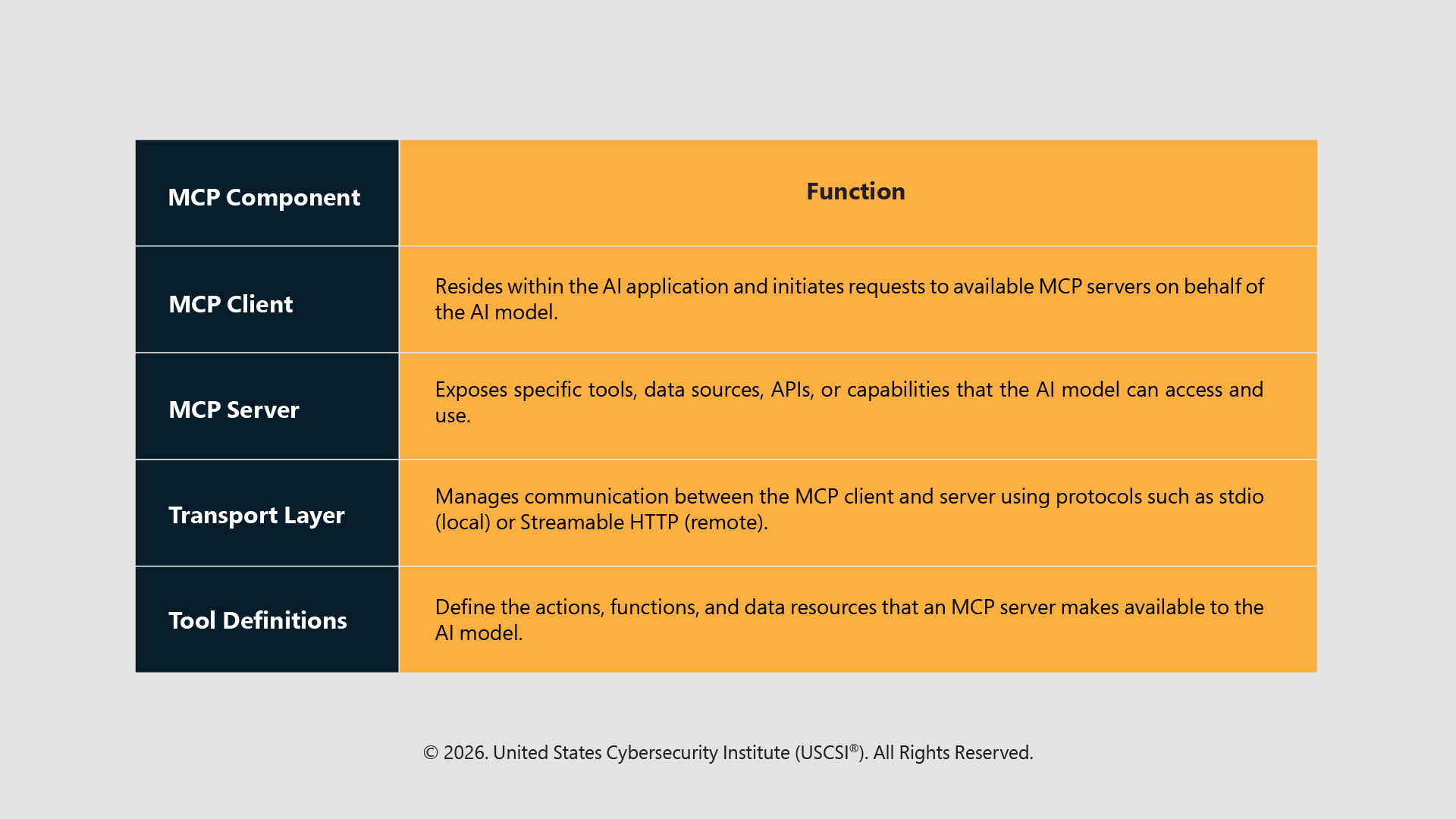
MCP is a client server-based system. An MCP client (usually embedded in an AI application) logs in to one or more MCP servers, which present different tools, data, or features that the AI model can access.
Why MCP Matters for Modern AI Systems
Before MCP, connecting an AI model to external tools meant building a custom integration for every single combination of model and tool. MCP removes that redundancy. A tool built once as an MCP server can work with any MCP-compatible AI application, whether that is Claude, ChatGPT, or a developer's custom-built agent.
This matters increasingly as enterprises move from single AI chatbots toward AI agents capable of taking real action, searching internal systems, updating records, or executing workflows across multiple platforms.
Enterprise-ready agents like Microsoft Copilot Studio, Devin AI, and IBM Watsonx Assistant are increasingly built to plug into workflows this way, relying on developer frameworks like LangGraph and AutoGen or no-code platforms such as Dify and n8n, many of which connect to external tools through MCP under the hood. USAII's comparative guide to AI agents in 2026 breaks down these tools and frameworks in more detail.
Key Use Cases for MCP
- AI coding assistants connecting to GitHub, GitLab, or internal codebases to read and modify code directly.
- Enterprise data access, letting AI models query internal databases like MongoDB without custom API work.
- Financial workflows, including PayPal's production MCP deployment for payment processing and fraud detection,
- Knowledge management, where MCP connects AI models to internal documentation and knowledge bases.
For a broader look at the frameworks and platforms powering these use cases, USAII's comparative guide to AI agents in 2026 breaks down the tools built on protocols like MCP that enable this kind of agent-driven automation.
Security Risks Associated with MCP
MCP's rapid adoption has introduced a distinct set of security concerns that organizations are still working through. Some of the key risks are.
- Tool poisoning, where an attacker modifies an MCP tool's description so the AI model misinterprets what it is actually calling.
- Prompt injection through tool responses, where malicious data returned by a compromised MCP server manipulates the AI model's behavior mid-task.
- Weak or missing authentication, since MCP itself functions as a transport layer rather than a built-in security framework, leaving protection largely to the surrounding infrastructure.
- Credential exposure, since MCP servers often request broad permission scopes and store sensitive credentials like API keys, creating a centralized target for attackers.
These risks compound with a broader enterprise problem that is unmanaged AI usage itself. USCSI's breakdown of prompt security in enterprise AI covers the layered defenses organizations are building to address exactly this kind of exposure.
Best Practices for Using MCP Securely
Securing MCP deployments comes down to treating authentication, access control, and monitoring as core requirements. Some of the best practices are listed below.
- Verify server sources before connecting, especially for public, community-maintained MCP servers.
- Enforce OAuth or equivalent authentication rather than relying on default, unauthenticated access.
- Use sandboxed environments that limit what data and actions an AI model can access through a given server.
- Apply explicit approval steps for sensitive actions, rather than allowing automatic execution of high-risk tool calls.
- Monitor and audit tool usage continuously, since MCP's flexibility also means new integrations can introduce risk quickly.
Building the skills to manage these risks properly increasingly falls at the intersection of AI in cybersecurity expertise. USCSI® Cybersecurity Certifications helps cybersecurity professionals build the practical skills needed to secure modern AI systems, including protocol-level risks like those introduced by MCP.
Conclusion
MCP is quickly becoming foundational infrastructure for how AI systems interact with the real world, and its adoption curve shows no signs of slowing. But as with most fast-moving technical standards, security has lagged behind convenience. Organizations adopting MCP at scale need to treat authentication, server verification, and tool-level governance as first-class requirements, not afterthoughts bolted on once something goes wrong.
FAQs
Is MCP specific to one AI company or model?
No, MCP is an open standard now adopted across multiple providers, including Anthropic, OpenAI, Google, Microsoft, and IBM.
Do developers need to rebuild existing APIs to support MCP?
Not necessarily; many teams wrap existing APIs with an MCP server layer rather than rebuilding underlying systems from scratch.
What job roles are emerging around MCP and AI agent security?
Titles like AI Security Engineer, Agentic AI Governance Specialist, and MCP Integration Architect are emerging as organizations formalize how they secure and manage these systems.