Decoding Ciphers: What They Are and How They Work
Encryption tends to go unnoticed until it is threatened, and 2026 marks a real turning point on that front. The World Economic Forum's Global Cybersecurity Outlook 2026, published in collaboration with Accenture found that 37% of leaders expect quantum technologies to materially affect cybersecurity within the next 12 months, driven largely by quantum computing's growing threat to current cryptographic standards. The report has already prompted formal guidance to begin migrating toward post-quantum cryptographic algorithms aligned with NIST standards.
That shift makes understanding how ciphers actually work more relevant than ever. The sections below cover what a cipher is, how it functions, and the main types that matter in practice, along with where this quantum-driven change is headed
What is a Cipher?
A cipher is a procedure for transforming plaintext (ordinary readable data) into unreadable data called ciphertext and transforming back when necessary. The transformation is based on a key, a secret number that determines the exact manner in which the data is scrambled. If the key is not known, it is not possible to decrypt text into plain text without a high amount of computation.
The Purpose of a Cipher
Confidentiality is the main job. Integrity usually comes along with it. A few things fall under that umbrella:
- Keeping sensitive data unreadable without proper authorization.
- Getting access to communication, including messaging applications, email or web traffic in general.
- Ensuring that data has been transmitted without changing along the way.
- Supporting authentication including the logon process.
How a Cipher Works
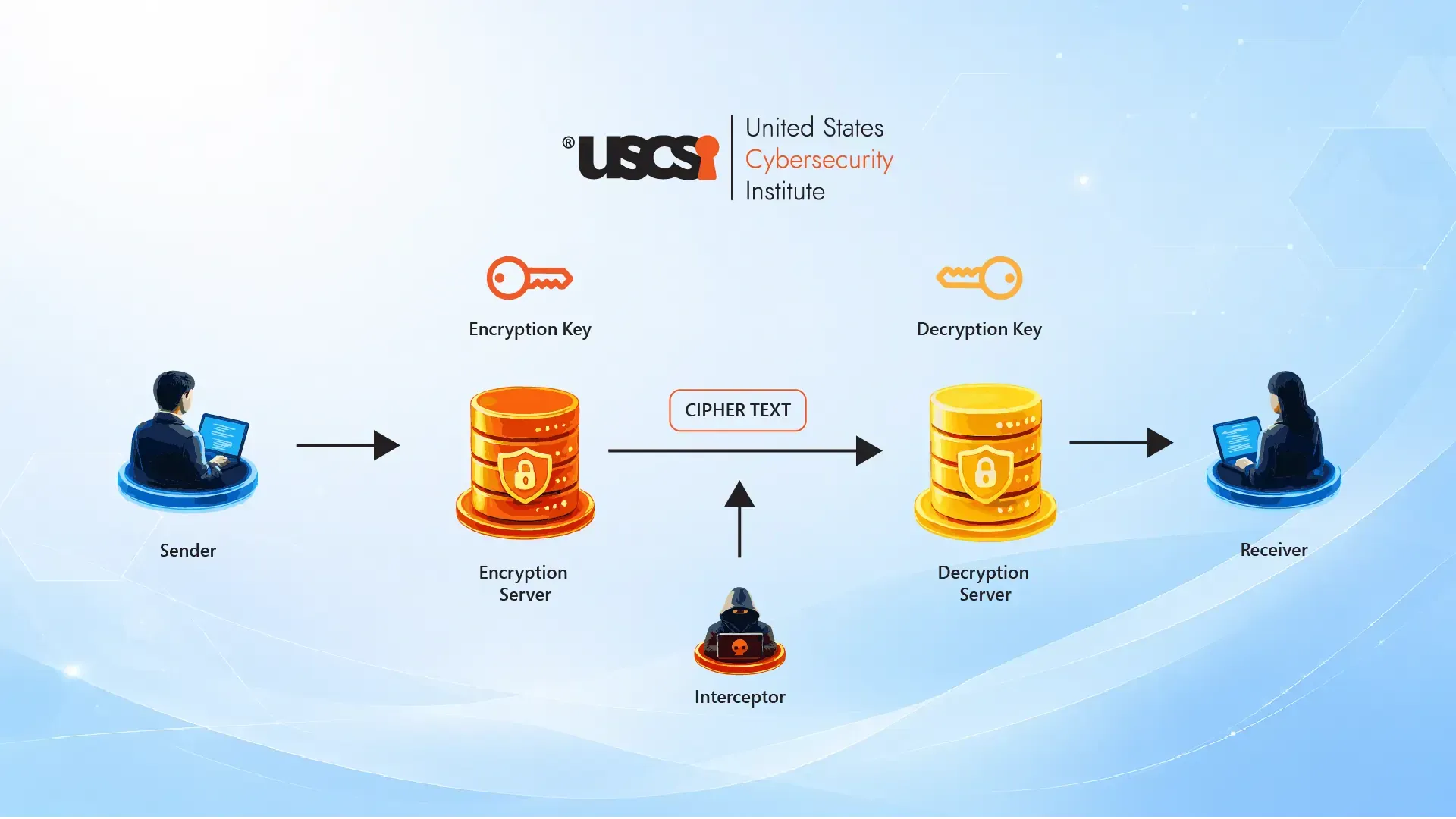
Plaintext and a key are introduced to the process together, and by using a mathematical transformation, the ciphertext is created. Decryption, the process of undoing the encryption, is done with the same key or a mathematically related key depending on the type of the cipher.
Typically, a message is encrypted by the sender using encryption key, and then the ciphertext is sent to the destination. Then the receiver uses a decryption key to get the original message. If an interceptor tries to intercept the data while it is being transmitted, he or she will only find ciphertext, which is too complicated to read without the key.
The strength of a cipher depends on many factors, such as the complexity of the algorithm, the length and unpredictability of the key. If the cipher is solid, it is difficult to break using brute force no matter what computing power is available.
Types of Ciphers
Ciphers generally fall into a few core categories, each built around a different approach to transforming data as listed below.
- Substitution Ciphers
There is a fixed rule for replacing each character in the plaintext with another character. The most famous and historic one is the Caesar cipher, but the sophistication of modern-day cryptography is much further than that.
- Transposition Ciphers
A transposition cipher is a cipher that does not use the characters of the plain text to create the cipher, but rather it uses a pattern to move the characters around. It's just the characters' locations who change, but the original content remains.
- Symmetric Ciphers
Only one key is used for encryption and decryption. Symmetrical ciphers are good for large volumes of data and the most widely used today is called AES.
- Asymmetric Ciphers
Here, two mathematically related keys are used; one public key to encrypt and one private key to decrypt. This is because the public key can be distributed publicly without compromising security, which is something that symmetric ciphers cannot do. The best known of these is RSA.
- Block Ciphers and Stream Ciphers
Block cipher is used to encrypt blocks of information, one block at a time. Stream cipher works on one bit or one byte of information at a time. The stream ciphers are normally used for streams of data, such as audio or video, while block ciphers are more likely to be used for structured data, such as files.
Ciphers vs. Codes: What's the Difference?
Cipher and code are often confused and used interchangeably, but they have certain distinctions. Cipher works on characters, without regards to their meaning. A code, by contrast, substitutes entire words or phrases using a predetermined reference, which requires a shared codebook rather than a mathematical key. Ciphers have become the standard in modern cryptography largely because they scale effectively, without depending on a static reference list.
Use Cases for Ciphers
Various everyday systems lean on cipher-based protection as listed below.
- Secure web browsing, where HTTPS pairs symmetric and asymmetric ciphers to protect data mid-transit.
- Locking down stored data on devices and servers, file and disk encryption.
- This is end-to-end encryption, which ensures that conversations are kept private in messaging apps.
- Digital signatures and certificates, which are based on asymmetric encryption to establish authenticity.
- Payment transactions, that are covered by encryption during processing.
Ciphers protect data itself, in storage or in transit, but that is only one layer of the bigger picture. Network security focuses on protecting data in transit through firewalls and traffic monitoring, while cybersecurity covers the broader scope of systems, applications, and users against threats like malware and identity-based attacks. USCSI's breakdown of network security vs. cybersecurity unpacks where each domain fits.
Building Cryptography Skills with USCSI® Certifications
Understanding ciphers conceptually is a fine start. Applying that knowledge in an actual security role is a different challenge entirely, one that calls for structured learning. USCSI® Cybersecurity Certifications CCC™ (Certified Cybersecurity Consultant) build cryptography and encryption fundamentals into a broader, applied curriculum, helping cybersecurity professionals move past theory into real implementation across systems and threat scenarios.
Conclusion
Ciphers remain foundational to modern security, working quietly behind nearly every digital interaction happening right now. Computing power keeps growing. Threats keep shifting. What counts as secure today won't necessarily hold that title indefinitely. That's exactly why cryptographic literacy needs ongoing attention rather than a one-time setup nobody revisits.
FAQs
Why do organizations sometimes use both symmetric and asymmetric ciphers?
It's a speed-and-security tradeoff. Asymmetric ciphers manage the secure key exchange, then a faster symmetric cipher takes over for the bulk encryption work.
How often should encryption keys be rotated for strong security?
Depends on the use case and compliance requirements, though many organizations rotate keys on a fixed schedule, annually being common, or immediately after any suspected compromise.
What skills should someone learn to build a career in cryptography?
A solid grounding in discrete math and number theory, plus hands-on experience with cryptographic libraries like OpenSSL, covers most of what employers look for.