Why Every Organization Needs CISO-Level Cybersecurity Leadership
Cybersecurity has moved from a technical discipline to a boardroom governance imperative. Yet most organisations still lack the one function designed to lead it. According to the 2026 CISO Report by Cybersecurity Ventures and Sophos, there are only 35,000 CISOs serving an estimated 359 million businesses worldwide, a 10,000-to-one ratio that captures the scale of the problem precisely.
This is not a talent pipeline issue alone. It is a structural leadership failure that leaves the majority of organisations exposed to threats, regulatory consequences, and financial losses they are not equipped to govern.
What a CISO Actually Does and Why It Cannot Be Substituted
The CISO role sits at the intersection of business strategy, legal accountability, and risk governance, not merely senior IT management. Without this function, the following critical responsibilities go unowned:
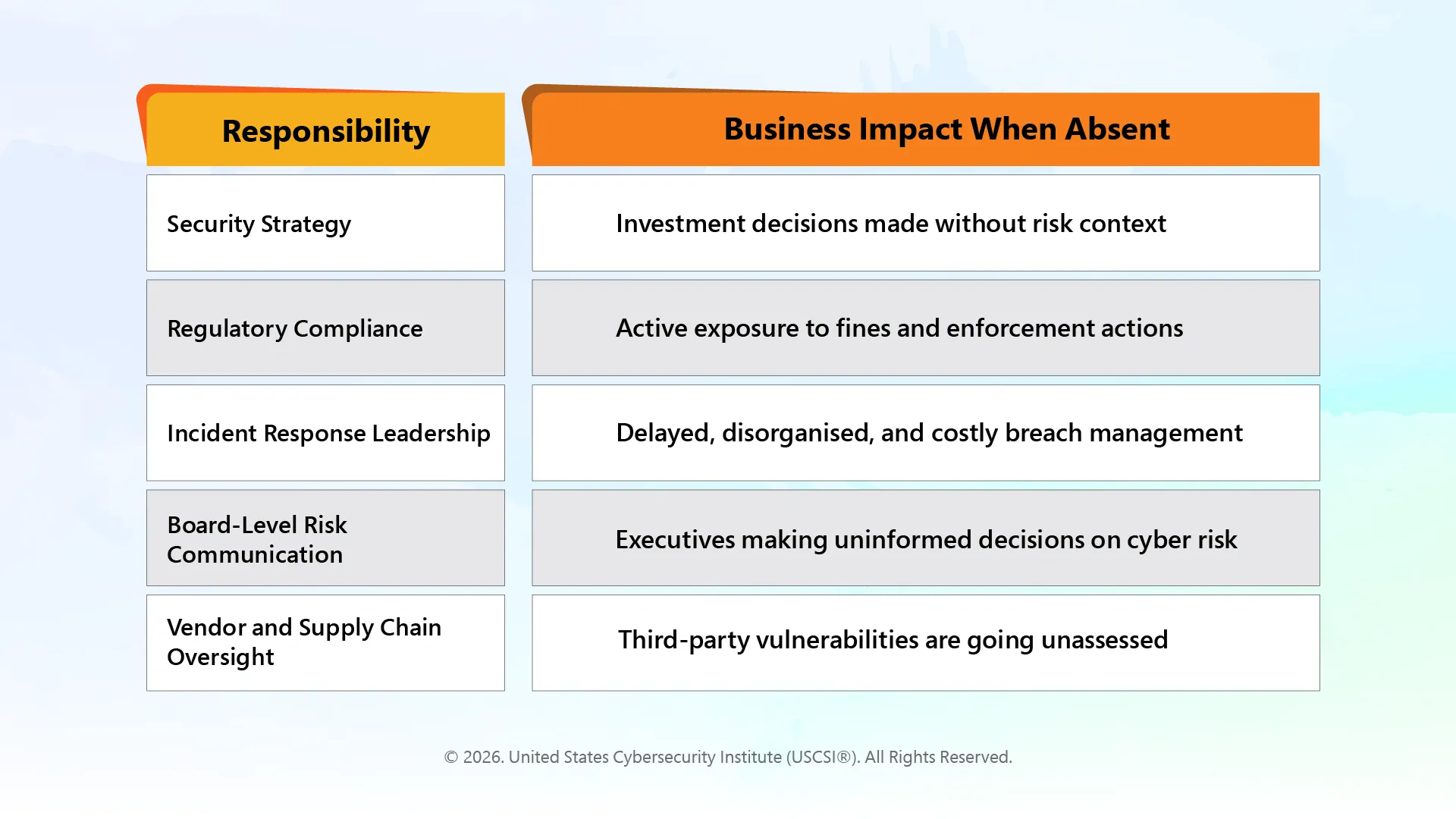
The gap is not theoretical. It produces measurable consequences across every one of these dimensions simultaneously.
Looking to understand the CISO role in greater depth? Download the Guide to the CISO of 2026: Role, Skills and Authority for a comprehensive breakdown of what modern cybersecurity leadership demands, and what it takes to step into it.
Why the Gap Is Widening in 2026
Several converging forces have made the CISO shortage more acute this year than in any previous period.
Regulatory Pressure Is Intensifying Accountability At The Top
Frameworks including NIS2, DORA, and SEC disclosure rules now function as active enforcement instruments. Inaction carries direct financial and legal consequences for boards and executives personally.
The Threat Environment Has Outpaced Traditional Governance Models
The IBM X-Force Threat Intelligence Index 2026 documents a 44% year-over-year increase in attacks exploiting public-facing applications, accelerated by AI tools that identify vulnerabilities faster than organisations can remediate them.
The CISO Role Itself Has Become Structurally Demanding
Personal legal liability, expanding scope, and constrained budgets have driven experienced professionals out of the position. Gartner's Predicts 2026 notes that by 2028, 50% of CISOs will be asked to own disaster recovery in addition to incident response, making the role harder to fill precisely when demand is at its highest.
Governance Has Become A Commercial Requirement
Organisations that cannot demonstrate credible security leadership are increasingly disadvantaged in M&A processes, enterprise partnerships, and capital market activities, making the absence of a CISO a valuation concern, not merely a security one.
The Business Cost of Having No Cybersecurity Leader
The consequences of operating without a CISO extend well beyond the IT department.
On the compliance level
Without designated leadership owning the compliance programme, organisations risk active regulatory violations they may not even recognise, with executives bearing personal accountability regardless of their awareness. Governance gaps do not pause for budget cycles or hiring timelines.
On breach response
Forrester's 2026 Cybersecurity and Risk Predictions identifies agentic AI as an emerging cause of public breaches, where the absence of oversight frameworks turns routine AI deployments into liability events. Organisations without security leadership have no structured mechanism to anticipate or contain these incidents before they escalate.
On business survival
A leadership gap does not merely increase breach probability; it eliminates the organisational capacity to recover when one occurs. That distinction separates a contained incident from an existential one.
Closing the Gap: Cybersecurity Leadership Certification as a Strategic Path
For organisations that cannot immediately appoint a full-time CISO, the answer is not to defer governance; it is to build it internally. Structured senior-level development through a recognised top Cybersecurity Leadership Certification equips professionals with the strategic governance, risk management, and board-level communication capabilities the function demands.
A credentialled leader is a substantive, verifiable step toward closing the gap in a way that technology investment alone cannot replicate.
Your Leadership Path: CSCS™ by USCSI®
For senior professionals pursuing this path, the Certified Senior Cybersecurity Specialist (CSCS™) from the United States Cybersecurity Institute (USCSI®) is built for strategic leadership. The curriculum spans Security Leadership and Regulations, Risk Management, Business Continuity, and AI Concepts for cybersecurity professionals, the precise domains that define executive-level governance.
Building a Culture of Cybersecurity Leadership
Closing the CISO gap requires more than a single hire. It demands that cybersecurity leadership becomes an institutional priority embedded across every level of the organisation.
- Boards must engage with cyber risk as a governance matter equivalent to financial and operational risk, not a technical briefing reserved for crisis moments.
- Finance leadership must reclassify security investment as a business continuity expenditure rather than a discretionary cost.
- Legal and compliance teams must operate in active coordination with security functions, particularly as regulatory obligations tighten across NIS2, DORA, and SEC frameworks.
- Human resources must treat security leadership capability as a deliberate workforce priority, with succession planning that ensures governance continuity beyond any single individual.
Organisations that distribute this accountability across functions and build security governance from the board downward are structurally more resilient than those waiting for one executive appointment to resolve their exposure.
Conclusion
The organisations that will navigate 2026 and beyond with confidence are not necessarily those with the largest security budgets. They are the ones that have placed qualified, strategic leadership at the centre of their cybersecurity function.
The CISO gap will not close on its own; it closes when businesses make a deliberate decision to treat cybersecurity governance as a leadership responsibility rather than a technology problem. That decision starts at the board level, runs through every business function, and demands investment in the people equipped to lead it. The time to act on that decision is not after the next incident. It is now.
FAQs
What is the average salary of a CISO in the United States in 2026?
A CISO in the United States earns between $250,000 and $400,000 annually, reflecting the strategic weight and personal liability the role carries, as per Glassdoor.
How often should a CISO report to the board of directors?
A CISO should present a formal cybersecurity risk briefing to the board at least once per quarter to ensure leadership alignment on organisational threat exposure.
What is the difference between a CIO and a CISO?
A CIO oversees the broader technology strategy of an organisation, whereas a CISO holds exclusive accountability for information security governance, risk, and compliance.