Understanding Machine Identity Security (MIS) in Modern Cybersecurity
Understanding Machine Identities
Before diving into MIS, let us first understand what machine identities are.
A machine identity is simply a digital credential that non-human entities use to authenticate and communicate securely within systems. A machine identity can be of various forms, such as:
- API keys
- TLS/SSL certificates
- Service accounts
- OAuth tokens
- SSH keys, etc.
While human identities have credentials like usernames and passwords, machine identities are quite different. They facilitate automated processes such as service-to-service communication, data exchange, and infrastructure deployment.
If we talk about the modern IT environments, machine identities significantly outnumber human users, sometimes by 100:1 or even higher, because of the exponential growth of cloud-native architectures and automation.
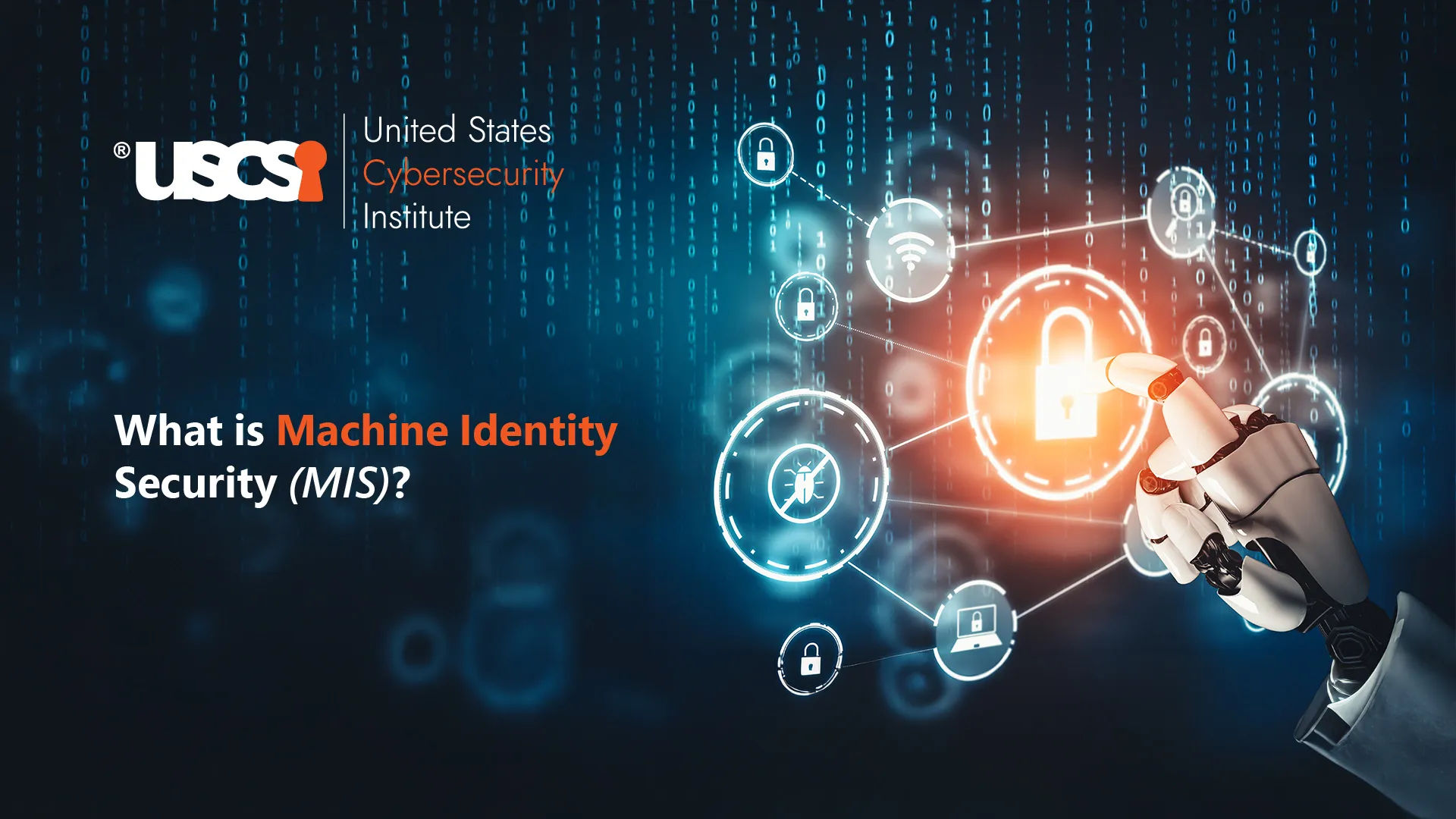
What is Machine Identity Security (MIS)?
Machine Identity Security (MIS) is the set of practices, tools, and policies needed to discover, manage, authenticate, and protect machine identities throughout their lifecycle. Only 12% of organizations have fully automated machine identity lifecycle management, leaving most environments exposed to manual errors and security gaps (Source: Manage Engine Report).
At the core, MIS helps ensure:
- Only trusted machines can access systems and data
- Machine credentials are issued, stored, and rotated securely
- Least privilege is applied to access permissions
- Suspicious and unauthorized machine activities are detected and mitigated effectively
MIS is an important element of identity security strategies that are responsible for securing both human and non-human identities across the enterprise.
Want to learn about MIS in detail? Enroll in comprehensive USCSI® cybersecurity certifications, exploring them in detail along with proper implementation strategies.
Why is Machine Identity Security Important in 2026?
Machine Identity Security is necessary for a number of reasons that organizations need to keep in mind.
- Explosion of Machine Identities
This is the biggest reason. The greater the number of machine identities, the greater the need for machine identity security. The rise of cloud computing, DevOps, and AI agents has led to an explosion of machine identities at an unprecedented rate. Since they run continuously and autonomously, they increase the attack surface.
- High-value Attack Targets
Attackers increasingly target machine credentials, as they will grant them access to essential resources. Because of compromised API keys or certificates, attackers can move laterally across systems even without detection.
- Lack of visibility and Ownership
Many organizations do not maintain a proper inventory of machine identities. This leads to some of the identities being overprivileged, having no clear owner, or rarely being rotated. This lack of visibility can lead to greater security risks.
77% believe every undiscovered machine identity is a potential security risk, emphasizing the importance of visibility and inventory. (Source: Cyber Ark)
Essential Components of Machine Identity Architecture
An effective Machine Identity Architecture involves the following key components that provide a structured foundation to secure machine identities:
- Discovery and Inventory
Organizations should be able to identify all machine identities across their environment, both hidden as well as unmanaged credentials.
- Secrets and Key Vaulting
This is another important component in a machine identity security (MIS) program that ensures credentials are securely stored using vaults, HSMs or KSMs, and prevents data theft.
- Automated Provisioning and Rotation
It takes over manual processes by continuously issuing and renewing short-lived credentials, and thus reducing risk.
- Policy Enforcement and Governance
It applies strict access controls and ensures a zero-trust security model is implemented for least privilege access and compliance.
Combined, these four pillars help with effective machine identity management that is secure, scalable, and automated.
How Machine Identity Security Works?
A machine identity security (MIS) program works by using multiple security controls across the environment to address machine identity threats.
- Identity Issuance
The first step is to assign unique identities to machines, such as certificates or tokens
- Secure Storage
It is followed by securely storing the credentials in vaults or key management systems
- Verification
Systems then verify machine identities before access is granted
- Access Enforcement
Policies enforce least privilege access
- Continuous Monitoring
The system detects anomalies and potential machine identity threats through behavioral analytics
This working principle is similar to that of a Zero-trust security model in which no entity, be it human or machine, is trusted by default.
Common MIS Use Cases
Here are some common applications where MIS is used to secure the digital credentials of machines.
- Securing APIs
APIs heavily rely on machine identities for authentication. MIS helps protect API keys and tokens from getting stolen or misused
- Protecting Cloud Workloads
Cloud environments use dynamic workloads like containers and serverless functions. All these require identities to be secured
- DevOps and CI/CD Pipelines
MIS also helps prevent unauthorized access and secures pipelines, as automation tools and pipelines mostly use machine credentials to deploy code.
- IoT Security
IoT devices use machine identities to communicate with systems. So, effective machine identity management is needed to secure them from breaches.
Challenges in Implementing Machine Identity Security
Machine Identity Security is important, but it is not without challenges, which include:
- Complexity
Machine identities could be in thousands or even millions, and managing them across hybrid environments could be complex.
- Short-Lived vs. Long-Lived Credentials
Short-lived credentials improve security, but they require greater automation and infrastructure
- Shadow Identities
There could be huge amounts of unmanaged and unknown identities outside the official systems that could increase risk
- Misconfigurations
Misconfigurations are another huge problem for effective machine identity management, arising because of excess permissions or improperly configured credentials
- Lack of Automation
A lot of organizations still rely on manual processes that can be prone to errors and might be inefficient.
How to Implement Machine Identity Security Properly?
Here are some best practices organizations must follow to effectively implement machine identity security (MIS) programs:
- Adopt a Zero Trust Approach: Always verify machine identities and implement strict access controls
- Implement Least Privilege Access: Only grant the least permission to machines needed for each of them
- Automate Identity Lifecycle Management: Automate provisioning, rotation, and revocation of credentials. This will help reduce risk
- Use Short-Lived Credentials: Long-lived credentials should be replaced with temporary tokens or certificates
- Monitor and Audit Continuously: Always track machine activity and audit access patterns to detect anomalies
Summing Up!
Machine Identity Security (MIS) is an important practice needed to secure non-human identities that are powering modern digital infrastructure. As the number of machine identities has significantly surpassed human users, the need for MIS has never been more important than now.
Organizations must therefore implement robust MIS strategies that focus on visibility, automation, least privilege, and continuous monitoring so that they can reduce the increasing attack surface and protect against various kinds of machine identity threats.
As automation and AI are taking over everything, the need to secure machine identities is becoming the top priority for organizations. In fact, it is now the foundational requirement for a robust security posture within an organization.