Agentic AI vs Cloud Threats: How Enterprise Security Is Evolving
Cloud attacks are no longer rare events; they are an everyday reality of doing business. CrowdStrike's 2026 Global Threat Report found that AI enabled adversary operations jumped 89% in the past year, and cloud conscious intrusions tied to state linked actors rose a staggering 266% in 2025.
Meanwhile, the Fortinet 2026 State of Cloud Security Report surveyed over 1,163 senior cybersecurity leaders and landed on a term that's since stuck around in security circles: the "complexity gap." Basically, cloud environments are expanding faster than most teams can watch them.
Cloud threats have gotten sharper as companies push deeper into SaaS, IaaS, PaaS, hybrid cloud, and multi cloud setups. This is where Agentic AI starts to make a real difference, shifting security from reactive alerting to something closer to autonomous defense.
Below, we'll look at how agentic AI cloud security is changing enterprise cloud security, and why so many professionals are now turning to cybersecurity certifications to build the skills this shift demands.
What Is Agentic AI and Why Does It Matter for Cloud Security?
Agentic AI describes systems that can observe, reason through a problem, decide, and then act, largely on their own, which is different from generative AI, which is mostly about producing content on request. An agentic system is built to make judgment calls using live data and business context, and it keeps adjusting as new attack techniques show up.
This distinction actually matters a lot for AI cloud security. A conventional tool flags something odd and then waits for a human to look at it. An agentic system investigates the anomaly itself, cross checks it against other signals, and in many cases contains it before an analyst even opens the alert. This is the backbone of what's increasingly called autonomous cloud security, and it's fast becoming table stakes rather than a nice to have.
Why Are Cloud Threats Outpacing Traditional Defenses?
Enterprises keep spreading workloads across more platforms, and every new service, API, or identity is one more door someone could try to open. Older tools were designed for a slower, more predictable world. They just weren't built for this pace.
A few things are driving the shift:
- Credential and identity theft: attackers grab API keys, tokens, and passwords to slip in unnoticed
- Cloud misconfigurations: one wrong setting and a storage bucket is suddenly public
- API exploitation: poorly monitored APIs give attackers an easy way in
- Privilege escalation: a low level account becomes an admin account if permissions aren't tight
- AI powered malware: code that changes its own behavior to slip past detection
- Multi cloud sprawl: more platforms means more things that can quietly go wrong
How Does Agentic AI Compare to Traditional Cloud Security?
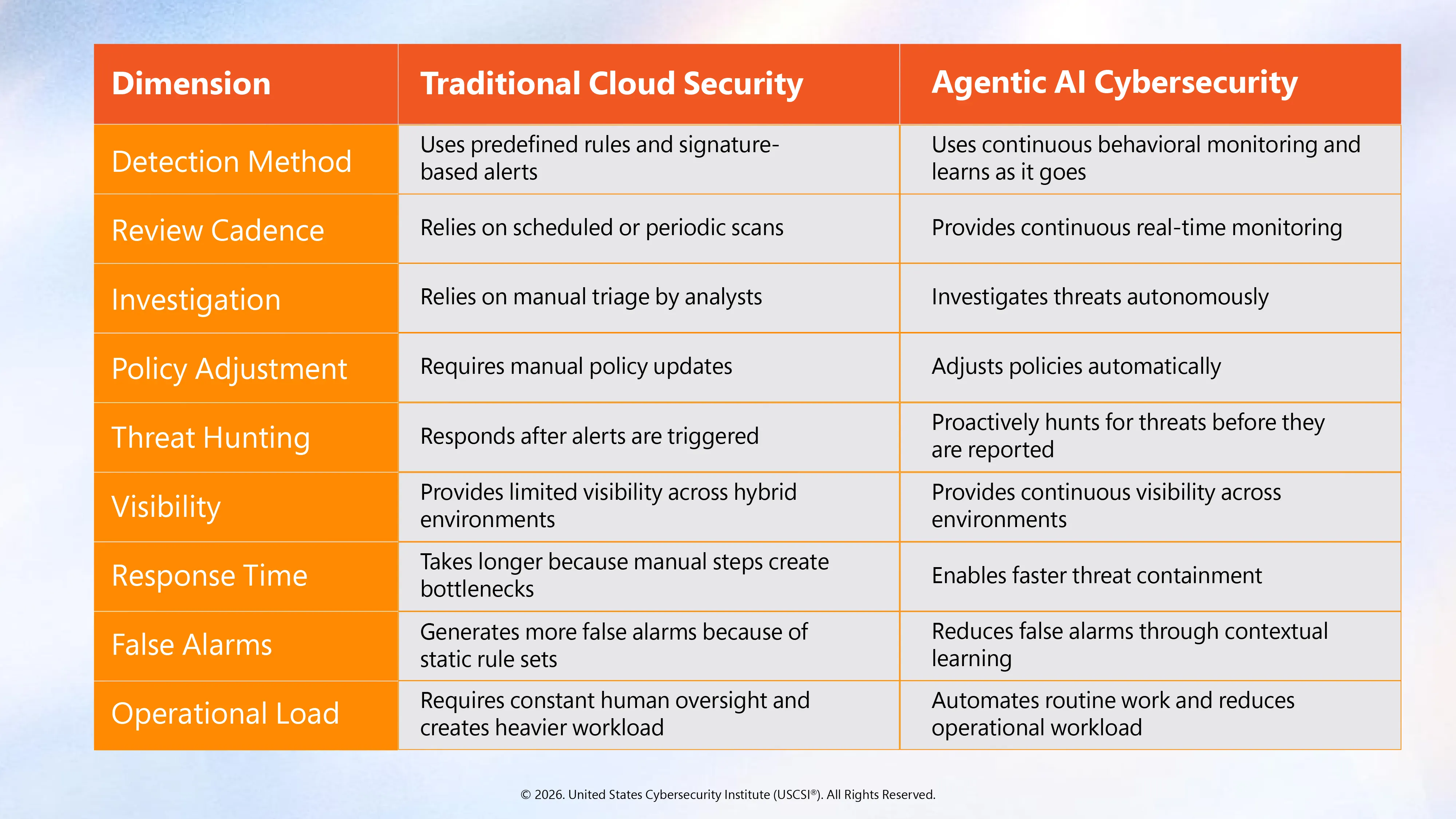
Traditional cloud security solutions lean on predefined rules, scheduled scans, and manual triage, and all of that takes time attackers don't give you. Agentic AI works differently, runs continuously, and it learns as it goes.
How Does Agentic AI Detect and Stop Cloud Threats in Real Time?
Good cloud threat detection doesn't wait around for a known signature to match. Instead, agentic systems build a behavioral baseline for every user, device, and workload, then pay attention when something drifts from that baseline.
A few of the core capabilities involved:
- Continuous behavioral analysis across users, devices, and workloads
- Identity risk scoring that catches suspicious access attempts early
- Predictive analytics flagging likely attacks before they cause damage
- Automated root cause investigation, no analyst required to start it
- Ongoing discovery of misconfigurations before someone else finds them first
How Does Agentic AI Strengthen Zero Trust Architecture?
Zero trust security has always rested on one idea. Never assume trust, always verify. Agentic AI pushes that further by verifying constantly instead of just once at login. It checks device health, watches sessions as they happen, and adjusts access on the fly based on risk.
This pairing supports zero trust architecture in some very practical ways, including least privilege enforcement, risk based authentication, and much tighter control over privileged accounts. Together, these cut down the damage a single compromised identity can do, and identity compromise is still one of the most common ways attackers get in to begin with.
Why Are Cybersecurity Certifications Becoming Essential for This Shift?
As companies rebuild their defenses around agentic systems and stronger cloud infrastructure security, the demand for people who understand both AI and cloud risk keeps climbing. Employers aren't just hiring for firewall knowledge anymore. They want people who can evaluate autonomous tools, read risk scores correctly, and connect security operations back to compliance requirements.
That's really where structured cybersecurity certifications come in. USCSI® runs a well regarded cybersecurity course that mixes practical, current material with the applied knowledge employers actually look for during hiring. For anyone building a long term cybersecurity career, a certification tells employers you're ready for the AI driven security world companies are already operating in.
Conclusion
At its core, the contest between agentic AI and cloud threats comes down to speed. Attackers automate, so defenses have to automate too, there isn't really a way around it. Enterprises pairing zero trust architecture with autonomous detection and response are in a much better position to absorb attacks that would have buried traditional teams just a few years back. And for anyone watching this shift happen in real time, now's a genuinely good moment to build the skills that will shape the next decade of security work. A recognized certification is one of the clearer paths to get there.