Cybersecurity is Everyone’s Job: Here’s What That Really Means
Somewhere in your organization, an AI agent probably has access to customer data right now. Someone in operations configured it last quarter to save a few hours on routine reporting. It holds credentials; it can trigger business processes, and it acts without human context or accountability. Nobody on the security team approved it, largely because nobody on the security team was ever asked. Situations like that one is why Cybersecurity skills have stopped being a specialist concern.
That scenario is neither hypothetical nor unusual in any meaningful sense. Gartner expects that by 2028, 70% of CISOs will be using identity visibility and intelligence capabilities to shrink the IAM attack surface and reduce the risk of credential compromise. Seven in ten security chiefs are moving to find out who and what actually holds access inside their own organizations, which tells you how little visibility most of them have today.
Attack Surface Has Moved Toward People
Modern intrusions rarely begin with an attacker defeating a sophisticated technical control. They begin with credentials that were handed over, reused, or quietly granted to an unauthorized person or device. Those credentials come from someone clicking a convincing link, someone recycling a password across systems, or someone approving an access request that looked entirely routine at the time.
Darktrace found in its 2026 State of AI Cybersecurity Report that 73% of security professionals say AI-driven threats are already having a significant impact on their organizations. The concern is clearly widespread, yet adoption continues regardless, because these tools solve real problems for the people reaching for them.
Why Not Everyone Needs the Same Level of Expertise
Saying that cybersecurity belongs to everyone does not mean everyone should retrain as a security analyst. Exposure differs enormously between roles, which means the training attached to each role should differ just as much.
For instance, a finance clerk needs to recognize a fraudulent payment request before authorizing the transfer, while a systems administrator controls access to infrastructure the entire business depends on.
A workable progression across an organization tends to look something like this:
- Employees need Cybersecurity Awareness training covering phishing recognition, safe data handling, and responsible use of AI tools at work.
- IT professionals need working competence across network, identity, endpoint, cloud, and application security in their daily environment.
- Aspiring specialists need genuine capability in threat analysis, vulnerability management, and structured incident response under real pressure.
- Experienced professionals need depth in security architecture, governance, risk management, and long-term cyber-defense strategy.
Awareness spread across the workforce prevents routine and avoidable mistakes, while expertise concentrated in the right roles builds a defense worth having.
Work Itself Is Changing Faster Than Most People Expect
Anyone planning to move into this field should look closely at where the work itself is heading. Gartner made a second prediction in that same March briefing which deserved more attention than it received. By 2028, half of all enterprise cybersecurity incident response effort will focus on incidents involving custom-built AI applications.
Read the above forecast carefully, because the wording is easy to misread. It does not say that AI will be handling incident response on our behalf. It says incident response will increasingly be consumed by the AI that other departments built and deployed. These applications are going live before anyone finishes testing them, and most security teams still have no clear process for handling AI-related incidents when those incidents eventually surface.
That reshapes what a security professional is actually paid to do each week. Half your future caseload may involve systems built by colleagues who never consulted you, running on tools you did not choose, holding permissions that nobody bothered to document. Structured Cybersecurity training programs matter more in that environment rather than less, because they connect awareness to foundation to application in a deliberate sequence.
If you are actively planning that transition, the 2026 Cybersecurity Career Switch Playbook walks through what moving into security from another discipline genuinely involves.
Gartner forecasts that the job market for securing AI will hit almost $4.8 billion in 2027, up 68.7% from 2026 and heading toward $7.7 billion by 2028. Yet in a Deloitte survey, 27% of respondents said the cybersecurity profession lacks clearly defined career paths to follow. Demand is obvious; the route is not. That’s why choosing the right credential from an internationally recognized institute or university is crucial.
USCSI® Certification Pathway
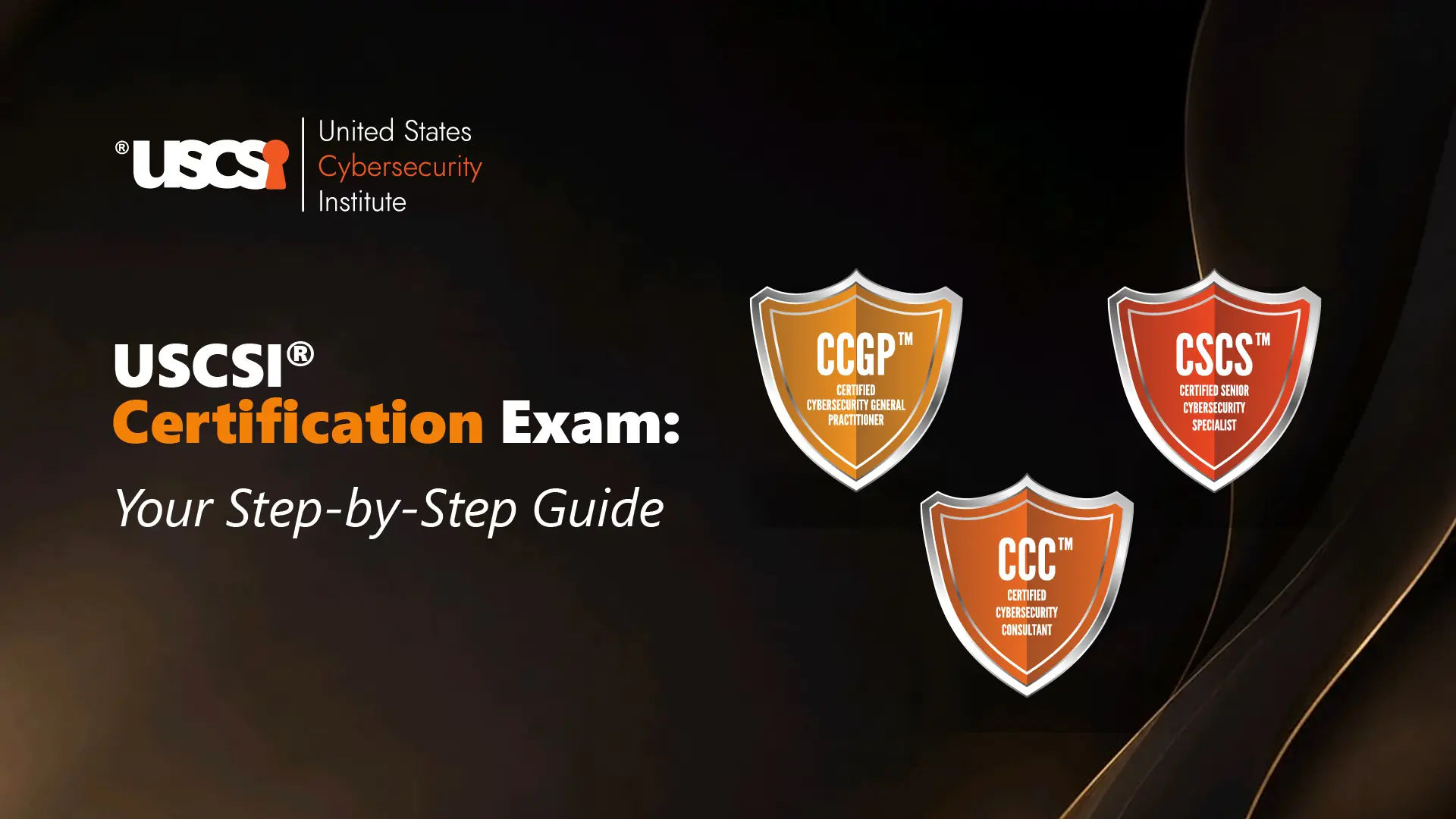
The United States Cybersecurity Institute, a member of the Institute for Credentialing Excellence, offers three credentials forming a deliberate sequence rather than three competing alternatives. Every examination follows an identical format, running 100 minutes as a computer-based multiple-choice paper with five options per question.
The USCSI® certifications are self-paced and built around vendor-agnostic curricula, so the knowledge stays useful when your employer changes its technology stack.
CCGP™: Certified Cybersecurity General Practitioner
Beginner level | 4 to 20 weeks | self-paced
- Entry requirements are unusually open, since no formal qualification and no prior work experience are needed to apply.
- The largest curriculum block covers phishing, social engineering, ransomware, smishing and vishing, macro malware, and banking trojans.
- Best fit is anyone beginning a Cybersecurity career from a non-technical or adjacent background.
CCC™: Certified Cybersecurity Consultant
Mid-level | 4 to 24 weeks | self-paced
- Three eligibility paths exist, and holding CCGP™ removes the work experience requirement from the process entirely.
- Best fit is a mid-level professional who already holds a working foundation in the field.
CSCS™: Certified Senior Cybersecurity Specialist
Senior level | 4 to 24 weeks | self-paced
- A dedicated section teaches evaluating your AI arsenal, meaning judging whether your security tooling genuinely performs as promised.
- Eligibility requires three years of experience with a Master's, five with a Bachelor's, or seven with an Associate degree.
- Roughly a third of this curriculum is artificial intelligence, which most summaries of the credential quietly overlook. Those AI modules cover malware threat detection, network anomaly detection, fraud prevention using cloud AI, and GAN attacks.
Explore the USCSI® Cybersecurity Salary Outlook 2026 and Beyond, which breaks down earnings across specializations and shows how credentials shape progression.
Wrap Up
We can now state plainly why cybersecurity has become everyone's job rather than one department's mandate. The tools people adopt, the access they request, and the requests they approve all carry security consequences, and none of those decisions can be made safely without some baseline awareness. Security stopped being a function the moment ordinary choices started determining whether an organization stays defensible.
The only real question remaining is what depth your particular role demands from you. Awareness is entirely sufficient for many people, others need genuine technical capability, and a smaller group needs the expertise to govern all of it properly. Matching your capability to your actual exposure is what turns a shared responsibility into a working defense.
Frequently Asked Questions
- Does every single employee genuinely need formal professional cybersecurity training?
No, although every employee needs awareness proportionate to the risk their role creates. Formal training should reflect your access level, your technical responsibility, and where you want your search for Cybersecurity jobs to eventually land.
- Can someone realistically enter this field without any prior experience?
Yes, and CCGP™ was designed for exactly that situation, requiring neither a qualification nor work experience. The certification ladder lets beginners progress in sequence rather than guessing at their next move.