How to Launch Your DevSecOps Consultant Career in 2026
As businesses accelerate digital transformation, delivering software quickly and securely is more important than ever. This has made DevSecOps one of the fastest-growing fields in cybersecurity. The DevSecOps market is projected to grow from $9.06 billion in 2025 to $22.74 billion by 2029, a CAGR of 25.9%, highlighting the rising demand for professionals who embed security throughout the software lifecycle.
At the center of this shift is the DevSecOps Consultant, with an average U.S. salary of $151,628 per year as per Glassdoor, reflecting the role’s value and demand. Unlike traditional approaches, DevSecOps integrates security directly into development and operations. If you’re planning a cybersecurity career in 2026 or aiming to advance your skills, this blog covers essential expertise, responsibilities, cybersecurity training, and growth opportunities.

What Does a DevSecOps Consultant Do?
As a DevSecOps Consultant, you would be responsible for integrating security into every phase of the software development process. DevSecOps differs from the way in which cybersecurity consultants have traditionally operated, where they perform checks after the deployed application has been created, by embedding security controls directly in the coding, build, test, and deploy phases of an application.
Their role typically includes:
- Designing and implementing secure CI/CD pipelines
- Automating security checks across development environments
- Performing code reviews, vulnerability scanning, and risk assessments
- Advising teams on secure coding and best DevOps practices
- Ensuring compliance with regulatory and industry standards
- Monitoring production environments for threats and incidents
- Collaborating with developers, operations staff, and cybersecurity experts
Why DevSecOps Matters Today
Companies are now moving at a faster pace with modern applications and utilizing Continuous Integration, Agile Development, Microservices, Cloud Native systems, and Rapid Deployment techniques, which allow them to develop and deploy vulnerabilities as quickly as they are creating new applications.
The business now expects:
- Faster deployment of products
- Greater compliance from Governmental bodies
- Lower Security Risk
- Fully Automated Governance
- Efficient Remediation
With these factors driving organizations to implement DevSecOps as a strategic part of their businesses and increasing the need for cybersecurity skills and DevOps tools knowledge globally. As organizations prioritize “secure-by-design”, DevSecOps Consultant jobs are growing across industries like finance, telecom, healthcare, SaaS, and government.
Essential Skills You Need to Become a DevSecOps Consultant
To succeed in this role, you need a well-rounded mix of development, operations, and security knowledge. As also highlighted in the recent USCSI® blog “Not-to-Miss Top Cybersecurity Skills for 2026”, the most in-demand skills focus on a combination of technical expertise, automation, cloud proficiency, and collaborative problem-solving. Here are the core DevSecOps skills:
Strong Programming & Scripting Skills: Languages like
- Python
- Bash
- Go
- Java
- PowerShell
Mastery of DevOps Tools: You should be comfortable with major automation and orchestration tools, including
- Git, GitHub, GitLab
- CI/CD tools (Jenkins, GitLab CI, GitHub Actions)
- Docker & Kubernetes
- Ansible, Terraform, Puppet
- Monitoring tools like Prometheus, Grafana, ELK
Cybersecurity Expertise: You must understand
- Threat modeling
- Secure coding practices
- Encryption
- Vulnerability management
- Identity & access management
- Zero Trust
- Cloud & container security
This combination sets you apart from a standard DevOps engineer.
Security Testing & Automation Tools: A DevSecOps Consultant uses automated security tools such as
- SAST (static code analysis)
- DAST (dynamic testing)
- SCA (dependency scanning)
- Container image scanning
- Secrets detection tools
- Runtime application self-protection (RASP) tools
Cloud Platform Knowledge: Most modern systems are cloud-based. You should understand
- AWS
- Microsoft Azure
- Google Cloud
- Serverless architectures
- Cloud compliance and shared-responsibility models
Soft Skills & Mindset: Since this role is collaborative, you need
- Clear communication
- Analytical problem-solving
- Documentation skills
- A mindset of continuous learning
Career Path to Becoming a DevSecOps Consultant
Your journey doesn’t have to be linear, but most successful consultants follow a path like:
Step 1: Build a Technical Foundation
Start with an IT, computer science, cybersecurity, or software development background. Even if you’re switching careers, hands-on labs and projects can close the gap.
Step 2: Get Experience in DevOps or Development
Work in roles like
- Software Developer
- DevOps Engineer
- Cloud Engineer
- System Administrator
This builds the operational understanding you’ll later secure.
Step 3: Learn Cybersecurity Essentials
- Secure SDLC
- Application security
- Network security
- Threat detection
- Vulnerability management
Step 4: Learn and Implement DevSecOps Tools
Start integrating scanners, security rules, and automated checks into pipelines.
Step 5: Move into DevSecOps or Security Engineer Positions
Begin applying DevSecOps solutions to real organizational problems.
Step 6: Grow Into a Consultant Role
You are prepared to work as a full DevSecOps Consultant once you can design secure CI/CD pipelines, counsel teams, conduct audits, and oversee security automation.
Eventually, you can even move into these domains of cybersecurity jobs in 2026:
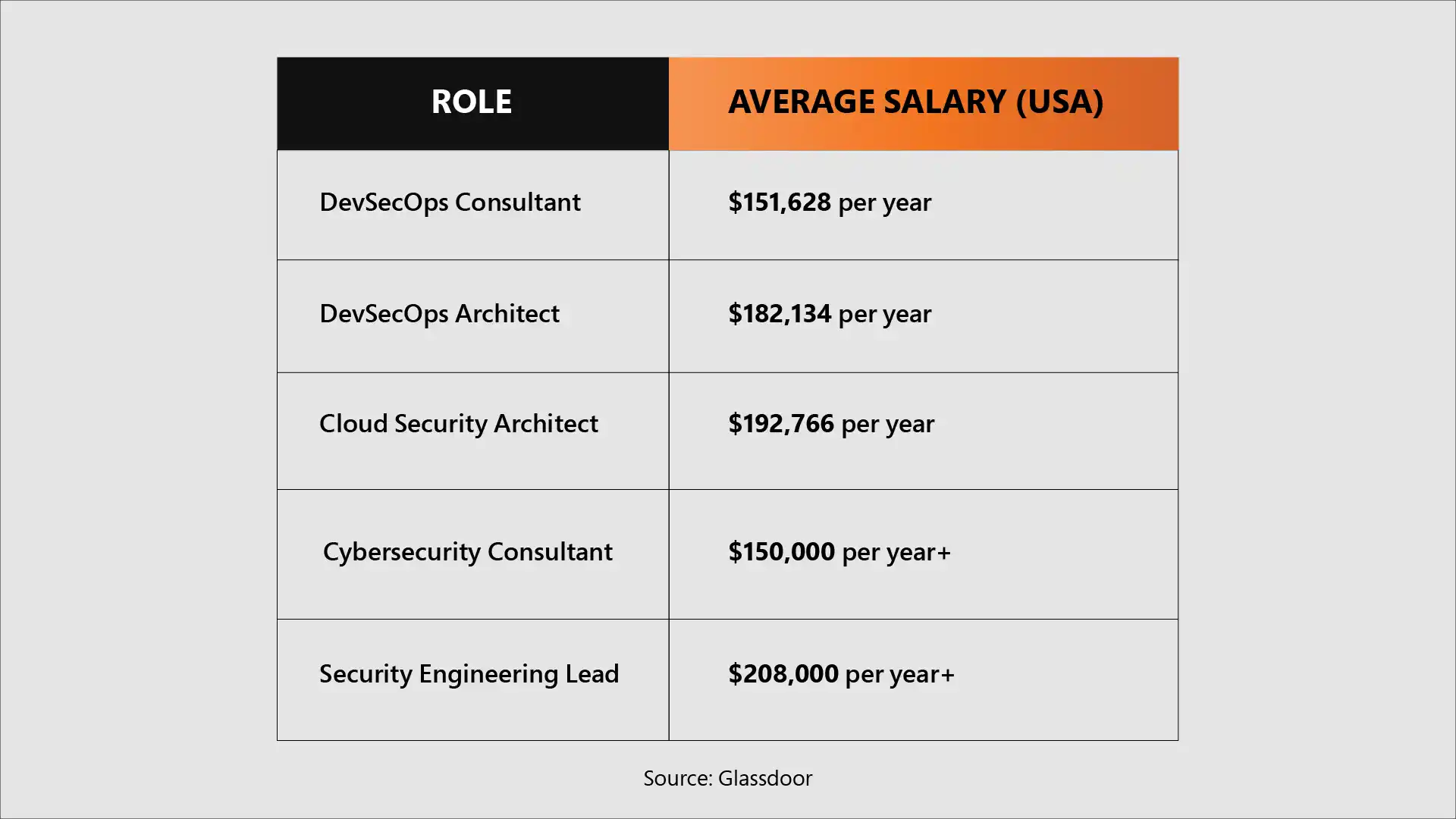
Salaries are based on Glassdoor estimates for the United States as of 2026 and may vary depending on experience, location, and organization size.
Future Trends Creating Opportunities in DevSecOps
The number of DevSecOps consultants will keep growing because of:
- Increasing cyber threats
- Cloud native application development.
- AI-driven automation
- Strict compliance laws
- Zero Trust adoption
- Growth of microservices and container structures.
With the evolving cybersecurity trends, consultants will be more helpful to companies since they can implement security, automation, and scale DevOps together.
Conclusion
The path of becoming a DevSecOps Consultant is a smart career choice one will make if they want to remain relevant in the current security-centric technological environment. The position is a hybrid of development, operations, and cybersecurity, which provides you with the opportunity to assist organizations in creating fast, scalable, and secure systems at the outset.
Your career trajectory in this industry will stay vigorous provided that you continue developing your practical skills, keep updated on the latest in the DevOps tools, and continue educating yourself on the new security practices.
For those looking to add more credibility to their consulting journey, pursuing a globally recognized, vendor-neutral cybersecurity certification like the Certified Cybersecurity Consultant (CCC™) by USCSI® can be a practical next step. It reinforces your advisory capabilities and helps you stand out in a competitive cybersecurity job market.
FAQs
- How long does it take to become a DevSecOps Consultant?
If you have a background in IT, software development, or cybersecurity, it usually takes 2–3 years of hands-on DevOps and security experience to become a competent DevSecOps Consultant. Career switchers may need additional time for practical projects and certifications.
- Are DevSecOps Consultants only needed in tech companies?
Not at all. While tech companies led adoption, industries like finance, healthcare, government, telecom, and SaaS are increasingly hiring DevSecOps consultants to ensure faster, secure software deployments and regulatory compliance.
-
How do DevSecOps Consultants stay updated with new threats?
Continuous learning is essential. Consultants stay informed by reading blogs and insights from credible sources like USCSI®, threat intelligence reports, and vendor updates, and by participating in hands-on labs or capture-the-flag exercises to stay ahead of vulnerabilities and evolving threats.