Data Science in Cybersecurity: Transforming Threat Detection and Career Paths
Cyberattacks keep climbing in both volume and sophistication, and organizations are under real pressure to respond faster than manual review ever allowed. KPMG's 2026 Cybersecurity & Technology Risk Survey found that 83% of security leaders saw an increase in attacks over the past year, with growing complexity cited as one of the biggest obstacles to keeping up.
Security teams aren't relying on manual processes the way they used to. Fortinet's 2026 Cybersecurity Skills Gap Report found that 91% of organizations are already using or experimenting with AI-powered security tools. There's a simple reason for that: cybersecurity has always come down to spotting patterns in huge volumes of data, and that's exactly what data science is to do.
How Data Science is Reshaping Cybersecurity Operations
Cybersecurity used to run almost entirely on fixed rules. A system flagged a threat if it matched a known signature, and nothing more. That worked fine when attacks looked similar year after year but left a lot of blind spots as attackers varied their methods.
Data science has changed the operating model, not just the detection logic. Models now process network traffic, login activity, and historical incident data continuously, learning what "normal" looks like and flagging anything that deviates from it.
This shift shows up in a few concrete ways:
- Alert volume becomes manageable. The Microsoft/Omdia State of the SOC 2026 report found that 46% of all alerts turn out to be false positives. Data science models score and rank alerts by severity, so teams spend less time chasing noise.
- Detection stops depending on prior knowledge of an attack. A model doesn't need to have seen a specific threat before to flag it as unusual.
- Security operations become part of a broader data strategy, pulling from the same infrastructure organizations already use for analytics, rather than sitting in a separate silo.
In practice, tools like natural language processing (catching phishing attempts outside known templates) and predictive models (prioritizing which vulnerabilities need urgent attention) are now embedded directly into daily security operations, not layered on as an afterthought.
How Data Science Detects and Predict Cyber Threats
Where the previous section covers how data science reshapes security operations broadly, this one gets specific: what does detection actually look like once these models are in place, and what kinds of threats do they catch?
Threat detection has historically meant finding out after the fact, once damage was already done. Data science moves that timeline earlier, catching signs of an attack while it is still unfolding rather than after it's finished.
Machine learning models trained on historical attack data are particularly good at recognizing:
- Ransomware activity before encryption starts, based on early file access and modification patterns that precede an actual lockout
- Lateral movement across a network, where an attacker who's gained initial access starts probing other systems
- Data transfer patterns that don't match normal traffic, which often signal exfiltration in progress
Behavioral analytics check whether the behavior around that login matches a user's usual pattern, time of day, location, and files typically accessed. That is often how account takeovers get caught, even with the correct password.
This is where cybersecurity in data science stops being an abstract concept and starts running the show: threat scoring, automated triage, and risk-based alerting, quietly doing work that used to take an analyst hours by hand.
Common Data Science Tools Used in Cybersecurity Today
Knowing the theory is one thing. Knowing what actually runs under the hood is another. Most security teams build their workflows around a fairly consistent set of tools.
- Python and R remain the go-to languages for building detection models and running statistical analysis on security data.
- SIEM platforms pull together log data across an organization and increasingly bake in machine learning for automated correlation.
- User and Entity Behavior Analytics (UEBA) tools apply behavioral modeling specifically to catch insider threats and compromised accounts.
- Open-source ML frameworks like TensorFlow and scikit-learn get used to build custom anomaly detection tuned to an organization's own traffic patterns.
Knowing your way around this toolkit is becoming a baseline part of cybersecurity skills for 2026, not something reserved for a separate data team.
Choosing a Career Path: Data Science, Cybersecurity, or Both?
Both fields are growing, and the overlap between them keeps expanding. The World Economic Forum's Future of Jobs Report ranks AI and big data as the fastest-growing skill category worldwide, with cybersecurity close behind.
Here is how the two compare in the US, based on current Glassdoor data:
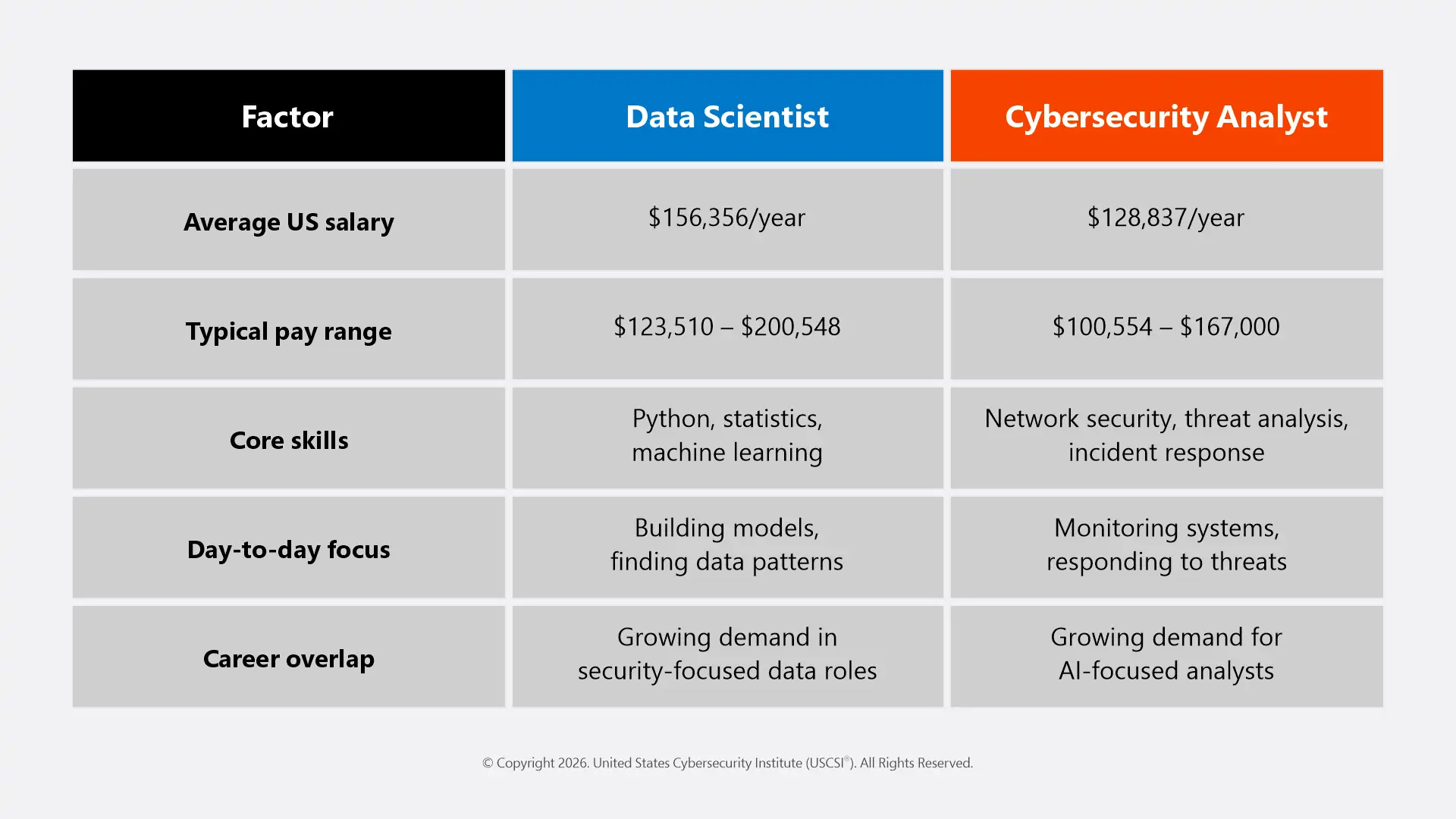
The role worth keeping an eye on is the security-focused data scientist, someone who can build statistical models and also understands how attackers actually operate.
For a closer look at how compensation is trending across cybersecurity roles specifically, USCSI's Cybersecurity Salary Outlook 2026 and Beyond breaks down salary bands by role and experience level.
This is not really a choice between two competing careers anymore. It is more a question of which foundation to build first and how much of the other discipline to pick up along the way.
Way Forward
Data science and cybersecurity are not running on separate tracks anymore. The cybersecurity tools protecting networks today are built on statistical models, and the people designing those models increasingly need security context to make them work in the real world.
For anyone looking to build credibility at any stage of that journey:
- USCSI® cybersecurity certifications span from foundational practitioner credentials to executive-level programs, built around practical threat detection, defense, and organizational leadership.
- USDSI® data science certifications scale the same way, from applied modeling and analytics at the individual contributor level through to data leadership and governance roles.
Whether the goal is to specialize or build that hybrid skill set, both offer a clear route from entry-level competency to leadership-level credibility.
FAQs
Do I need a cybersecurity background to work in security-focused data science?
Not necessarily, but knowing common attack patterns makes the modeling work a lot more useful.
Are data science skills useful for entry-level cybersecurity roles?
Yes, even basic data analysis skills help analysts read through logs and alerts faster.
Is cybersecurity a good career in 2026?
Yes. The World Economic Forum ranks cybersecurity among the fastest-growing skill categories globally, and demand continues to outpace supply.