DevSecOps vs. SecDevOps: Which Security Model Fits Your Business?
Cybersecurity is no longer an afterthought but a core element, especially when the software development is at its peak, and cyber threats are becoming more sophisticated. The traditional DevOps models are, of course, effective in improving speed and collaboration, but they fall short when it comes to integrating security controls right during the development lifecycle.
To address this, two distinct approaches, DevSecOps and SecDevOps, are highly beneficial. But what are they and how do they differ?
Often, these two terms are used interchangeably, but they represent different theories and priorities. So, to make the right choice between them, you should have a clear understanding that will help you build secure, scalable, and compliant software systems.
Understanding DevSecOps
Development, Security, and Operations, in short, DevSecOps, is an evolution of DevOps that also integrates security components into every phase of the software development lifecycle (SDLC) to make the application secure. Instead of leaving cybersecurity as an additional operation at the end of SDLC, DevSecOps emphasizes “security as code” and shared responsibility across development, security, and operations teams.
85% of organizations state that developers and security engineers are primarily responsible for application security, reinforcing the DevSecOps “shared responsibility” model. (Source: Gitlab)
In a DevSecOps model, developers are empowered with DevSecOps tools such as static application security testing (SAST), dynamic application security testing (DAST), container scanning, and infrastructure-as-code (IaC) security checks.
Cybersecurity professionals here provide the necessary cybersecurity frameworks, policies, and guardrails instead of manual approvals.
Key characteristics of DevSecOps include:
- Security is integrated right from design to deployment
- It relies heavily on automation and CI/CD pipelines
- Offers continuous monitoring and feedback
- Facilitates collaboration between Dev, Sec, and Ops teams
This approach is beneficial for organizations that prioritize speed, agility, and cloud-native development and need automated security controls.
With updated cybersecurity courses and certifications, professionals can learn the essential cybersecurity skills to integrate/implement security in DevSecOps.
Understanding SecDevOps
On the other hand, SecDevOps places security first in the development process. The sequence, Security, Development, Operations, shows that security requirements drive the design and development decisions from the outset.
In this approach, the cybersecurity experts first define the necessary architecture standards, compliance requirements, and security controls before the developers start coding. In highly regulated industries like healthcare, finance, defense, and other critical infrastructure domains, organizations often prefer SecDevOps over DevSecOps because in these industries, failure to meet security or compliance standards can have severe consequences.
Key characteristics of SecDevOps include:
- Design and architecture focused on security
- Strong governance and policy enforcement
- Greater emphasis on compliance
- Security teams closely working and leading in the early SDLC phases
Using SecDevOps tools during software development significantly reduce chances of security issues during the design; however, they add extra workload in planning and may slow down the release cycle if not implemented carefully.
DevSecOps and SecDevOps both are both useful in securing software applications, and the difference is only in their approach. With USCSI® cybersecurity certifications, professionals can master both these techniques and can reach a better position in deciding which would make more sense for their applications.
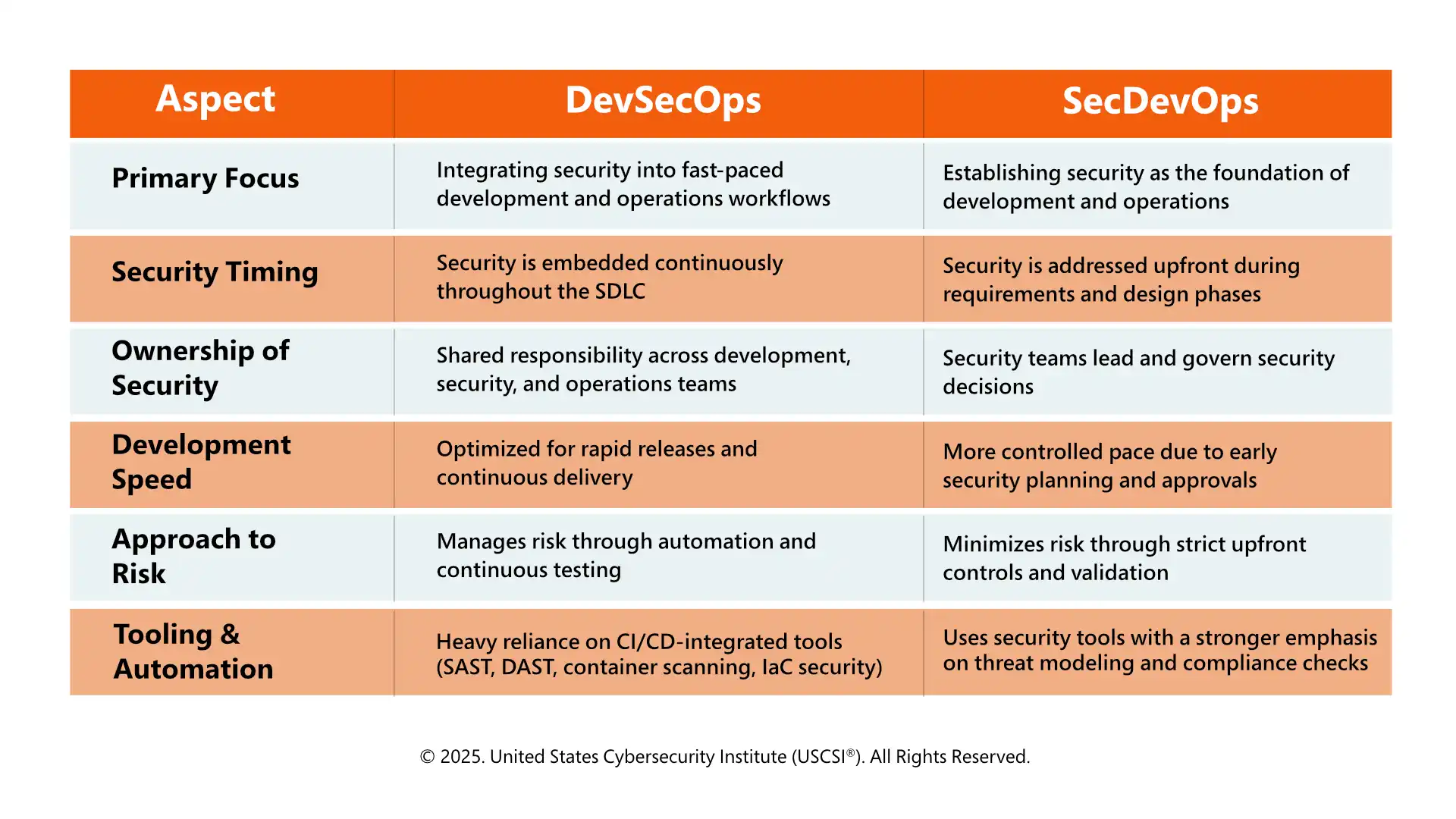
Key Differences Between DevSecOps and SecDevOps
Which Approach is Ideal?
Choosing between DevSecOps and SecDevOps mostly depends on an organization’s risk tolerance and regulatory and development requirements.
For organizations that release software frequently, operate in agile environments, and build cloud-native applications, DevSecOps will be the ideal choice. But remember, this approach works best when a mature DevOps pipeline and automation are in place. Because it allows organizations to scale security without affecting innovation.
Startups, SaaS providers, and digital enterprises often consider this approach as it aligns with continuous delivery and rapid change.
Contrary to this, SecDevOps is better suited for organizations operating in heavily regulated or high-risk environments. So, if your company handles sensitive financial, healthcare, or private data, and you need to comply with regulatory standards such as HIPAA, PCI DSS, or GDPR, then going for a security-first approach is recommended. In these cases, often governance and security are more important than the deployment speed.
In many cases, mature organizations can be found adopting a hybrid approach that blends some elements of DevSecOps and some of SecDevOps.
Organizations are embedding security controls directly into pipelines:
- 30% use Dynamic Application Security Testing (DAST)
- 29% use Static Application Security Testing (SAST)
- 27% use Software Composition Analysis (SCA)
- 23% generate Software Bills of Materials (SBOMs)
- 20% use container scanning and pipeline compliance tools (Source: Gitlab)
These practices align with DevSecOps automation, while also enabling SecDevOps-style governance when applied early.
For example, cybersecurity professionals lay out the core architectural principles and compliance requirements beforehand (SecDevOps), and the development teams integrate automated security testing into CI/CD pipelines (DevSecOps).
This allows organizations to maintain both strong governance along with agility and automation.
The final thoughts!
Though both DevSecOps and SecDevOps aim to enhance security into software development lifecycle, they serve different needs. While DevSecOps emphasizes speed, automation, and shared responsibility, SecDevOps prioritizes security-first design and governance. Thus, the former is suitable for agile and cloud-native environments, and the latter is useful for organizations operating in high-risk and regulated industries. No matter what, the demand for cybersecurity professionals is high across all industries and environments. With USCSI® certifications, you can master these approaches along with the latest cybersecurity tools and techniques. So, take the first step and enroll now to boost your credibility in the cybersecurity industry.
Frequently Asked Questions
Yes, when combined with policy-as-code, automated compliance checks, and strong governance, DevSecOps can effectively support standards like HIPAA or PCI DSS.
- Is DevSecOps more popular than SecDevOps?
DevSecOps is more widely adopted due to agile and cloud-native development growth, while SecDevOps is preferred in regulated, high-risk, compliance-driven environments.
- Can DevSecOps meet regulatory compliance requirements?
Yes, when combined with policy-as-code, automated compliance checks, and strong governance, DevSecOps can effectively support standards like HIPAA or PCI DSS.
- Do organizations need to choose only one approach?
No. Many organizations adopt a hybrid model, combining SecDevOps-driven security design with DevSecOps automation to balance compliance, speed, and scalability.