Learn Cybersecurity in 2026—From Zero to Pro
Cybersecurity is no longer a specialized skill reserved for IT professionals; it has become critical to the personal and professional success of individuals, as well as the survival of businesses and organizations. Each of our digital activities today creates an attack surface, and yet most people who use technology remain in denial about how exposed they have become.
This reality is already reflected in numbers. Skill shortages are no longer limited to entry-level positions but also affect mid- and senior-level positions. Security Magazine reported that 41% of organizations struggle to find and retain skilled cyber professionals in 2026.
What “Learning Cybersecurity in 2026” Actually Means?
Learning Cybersecurity isn't just about memorizing tools, commands, and definitions. True cybersecurity education is about learning to understand how attacks occur, why controls break down, and the ways decisions influence exposure.
With effective cybersecurity upskilling, you will be able to:
- Improved Accuracy of Threat Detection: Early detection of sophisticated malware, phishing, and zero-day threats.
- Incident Response Readiness: Faster breach containment with more structured response playbooks.
- Enterprise Risk Reduction: Lessens financial, legal, and reputational risks.
- Regulatory Compliance Strength: Align with international security and data protection regulations.
- Career Role Advancement: Become eligible for more advanced positions in cybersecurity.
It’s 2026, and cybersecurity skills are measured by the ability to make good decisions, not by familiarity with tools. Employers are looking for someone who can analyze situations, not just check off lists.
Set Your Focus: In-Demand Cybersecurity Skills in 2026
As you already know, the impact of effective cybersecurity upskilling, now let’s get straight into where you need to focus in 2026:
- AI Exploit Hunting: Learning to detect and defend against attacks that have been created or guided by AI beyond just malware.
- Digital Trust Engineering: Skills to analyze and validate identity, credentials, and interactions digitally within deep-fake-dense environments.
- Behavioral Threat Modeling: Anticipate the movements of an attacker by understanding the patterns of human decision-making and social engineering.
- Automated Security Validation: AI to evaluate whether measures in place actually work in real time, beyond just tool configurations.
- Cross-Domain Security Mapping: Applying non-digital domains (psychology, forensics, gaming) into actionable security domains.
- AI-Human Collaboration Mastery: Knowing the balance between reliance on AI and human decision-making, especially during emergencies.
- Quantum-Proof Thinking: Developing strategies and frameworks that are adaptable to the challenges of post-quantum cryptography.
- Permission Gravity Analysis: Recognizing latent threats that come from underestimated access or unused credentials.
The upskilling in the above cybersecurity can make 2026 the peak career advancement year for you. Which not only helps you safeguard enterprises from cyberattacks but also protects yourself from the advancement of AI-driven cyberthreats and digital attacks by gaining the right cybersecurity awareness.
Unsure which cybersecurity role will stay relevant and grow fastest in 2026? Get clarity with the USCSI® Cybersecurity Career Factsheet 2026—Download now!
Importance of Scenario-Based Cybersecurity Learning
It’s 2026, and scenario-based learning has created the benchmark in cybersecurity training. Scenario-based training does not have a theoretical foundation like many courses do; it puts participants in real attacks.
Key advantages include:
- How Ransomware Spreads Across Networks
- Phishing and identity theft response
- Secure System Design in the Real World
Understanding compliance failures through case-based governance scenarios. This approach to teaching the foundations of cybersecurity theory is further enhanced by bringing them into practice. Professionals trained in scenarios make fewer mistakes and are quicker to adjust under pressure — skills employers actively seek.
Why is the USCSI® Cybersecurity Program Right for You?
The USCSI® cybersecurity certifications provide real-world cybersecurity training, including scenario-based cybersecurity upskilling.
What sets USCSI® apart:
- Industry-specific training course reviewed by 20+ SMEs.
- USCSI®’s cybersecurity certifications are globally recognized in 150+ countries and provide 180+ learning hours and lifetime access to a study kit, including self-paced videos and eBooks.
- I.C.E. membership – guarantees compliance with American certification practices
- Modern updated cyber education programs, not an outdated curriculum.
- Enrollment benefits include special discounts (group and individual) on each cybersecurity certification, and you can also pay the fee in 3 easy EMIs.
This structure equips learners with practical cybersecurity skills that apply across various entry-level to senior-level roles in 2026 and beyond.
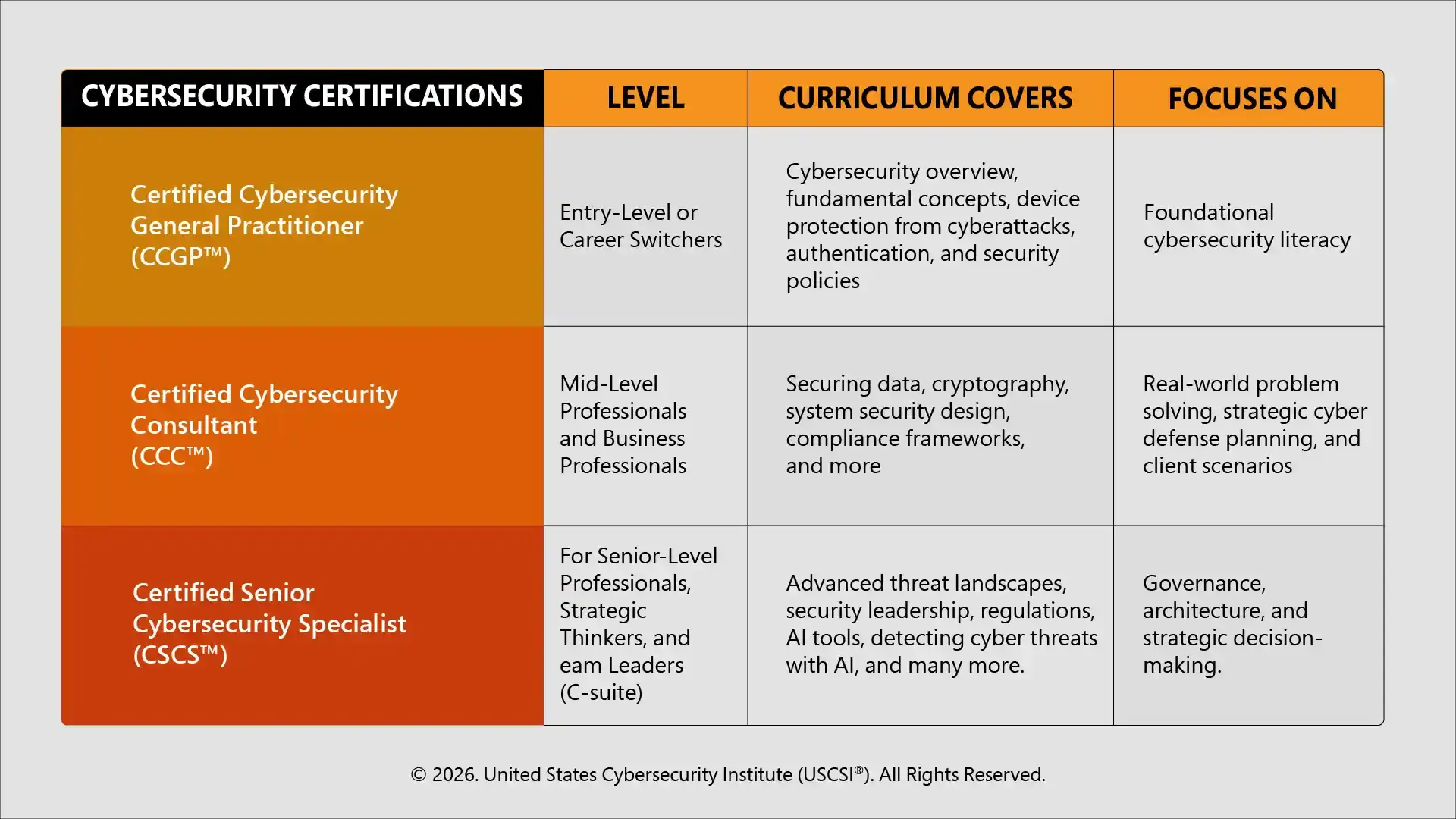
Cybersecurity Certification That Aligns with Your Goals
The best cybersecurity certification for you is going to vary depending on where you are in your career and where you want to go.
Non-Negotiable Area Needed to Focus in Cybersecurity
To succeed in the field of cybersecurity, professionals must build core competencies that go beyond tools.
- Technical Skills: Strong foundational knowledge of software and network security, threat detection, prevention and protection of knowledge, and vulnerability scanning.
- Ethical Awareness: Responsible disclosure, Privacy by design, and governance fit.
- Critical thinking: Risk assessment, incident prioritization, root cause analysis
- Lifelong Learning: Keeping up with the waves of cybersecurity trends 2026
Cover all these four major areas, and nobody can stop you from achieving success in the field of rapidly evolving cybersecurity in 2026 and beyond.
How to Get Certified?
The USCSI® certification process is a convenient, completely online program tailored to meet the needs of today’s workplace.
Steps include:
To select the best cybersecurity certification for your career in 2026, here are the steps you can follow:
- Select any among CCGP™, CCC™, or CSCS™, which suits your current career level.
- Click on the “Apply Now” button then create your USCSI® account.
- Check the PayEase Program, which provides you with two options (Pay in Full and Pay in 3 Installments) to pay the fee for the respective certification.
- Access the dashboard and get access to the USCSI®’s cybersecurity upskilling self-study kit (eBooks) and self-paced videos (if selected self-paced learning mode).
- Learn at your own pace through comprehensive eBooks, videos, labs, and more.
- Schedule your proctor online exam, which checks your competency to earn the respective certification.
Upon successful completion, learners receive a globally recognized cybersecurity certificate and digital badge, which they can showcase in LinkedIn profiles and resumes.
Use Your Certification to Land Cybersecurity Jobs
USCSI® certifications specifically complement positions, including the following:
- Cybersecurity Analyst or Intern
- SOC Analyst
- Network Security Engineer
- Cybersecurity Consultant
- CISO
- GRC Professional
- Penetration Tester
- Security Architect
- Cyber Risk Strategist
Along with labs, projects, or thought leadership content, certifications are an enabler for career progression – no matter the industry.
If you want to get deeper insights into the top cybersecurity salaries, download the USCSI® Cybersecurity Salary Handbook 2026 now!
2026 Path Forward: Making Cybersecurity Education a Priority
Cybersecurity is no longer optional knowledge. It is professional literacy. 2026 is your chance to quit kicking the learning can down the road and do something that will lead to defensible expertise. Opt for structured, case-driven vendor-agnostic education and get security-literate in a world that now requires it the most.
Take a step forward toward a successful career in cybersecurity. Begin cybersecurity upskilling now!
Frequently Asked Questions
-
Is cybersecurity learning possible without an IT background?
Yes, structured education programs for cybersecurity upskilling are meant to be beginner-friendly, irrespective of the background.
-
Are vendor-neutral cybersecurity certifications better in 2026?
Yes, vendor-neutral certifications such as USCSI®’s certifications have long-term value independent of tools and platforms.
-
How long does it take to build job-ready cybersecurity skills?
With concentrated, scenario-based cybersecurity learning, covering skill gaps as per today’s workplace demand, and a globally recognized certification that adds credibility to your acquired cybersecurity skills, you can become job-ready within just 4–6 months.