OpenClaw Security Crisis: Unpacking Agentic AI Risks In 2026
Autonomous agents are no longer being tested in controlled environments, they are running in production, executing code, browsing the web, and making decisions without waiting for human sign-off. That shift has consequences, and the numbers are starting to reflect them. Publicly reported vulnerabilities have crossed approximately 15,000 disclosures this year, with dozens explicitly tied to AI systems as per IBM X-Force's April 2026 analysis.
OpenClaw sits at the center of this conversation. Here is a closer look at what its security record reveals and what it means for every enterprise deploying autonomous AI.
What OpenClaw Is and Why It Matters
Formerly known as ClawdBot or MoltBot, OpenClaw is a self-hosted, autonomous AI agent. It browses the web, manages files, reads and writes data, and executes code locally, without requiring a human prompt for every action.
Weeks after launch, it became GitHub's most-starred repository. That scale brought a massive developer community and immediate security researcher attention.
Over 255 GitHub Security Advisories have been published against it. OpenClaw is not a theoretical risk. It is a documented, active vulnerability surface.
Why Agentic AI Breaks the Traditional Security Model
Traditional AI responds to a prompt and stops. Agentic AI pursues goals, chains actions, and operates without waiting for the next instruction. That distinction changes everything about how risk is assessed.
OpenClaw's architecture illustrates the exposure:
- Web browsing and external content retrieval
- Local file system access and code execution
- Messaging integrations, browser automation, SSH tooling
- An LLM coordinating all of the above
One leaked token can escalate to operator-level compromise, not from a single flaw, but from how these components chain together. Many of these failures carry no CVE identifier, making them invisible to the dashboards and compliance tools security teams rely on daily.
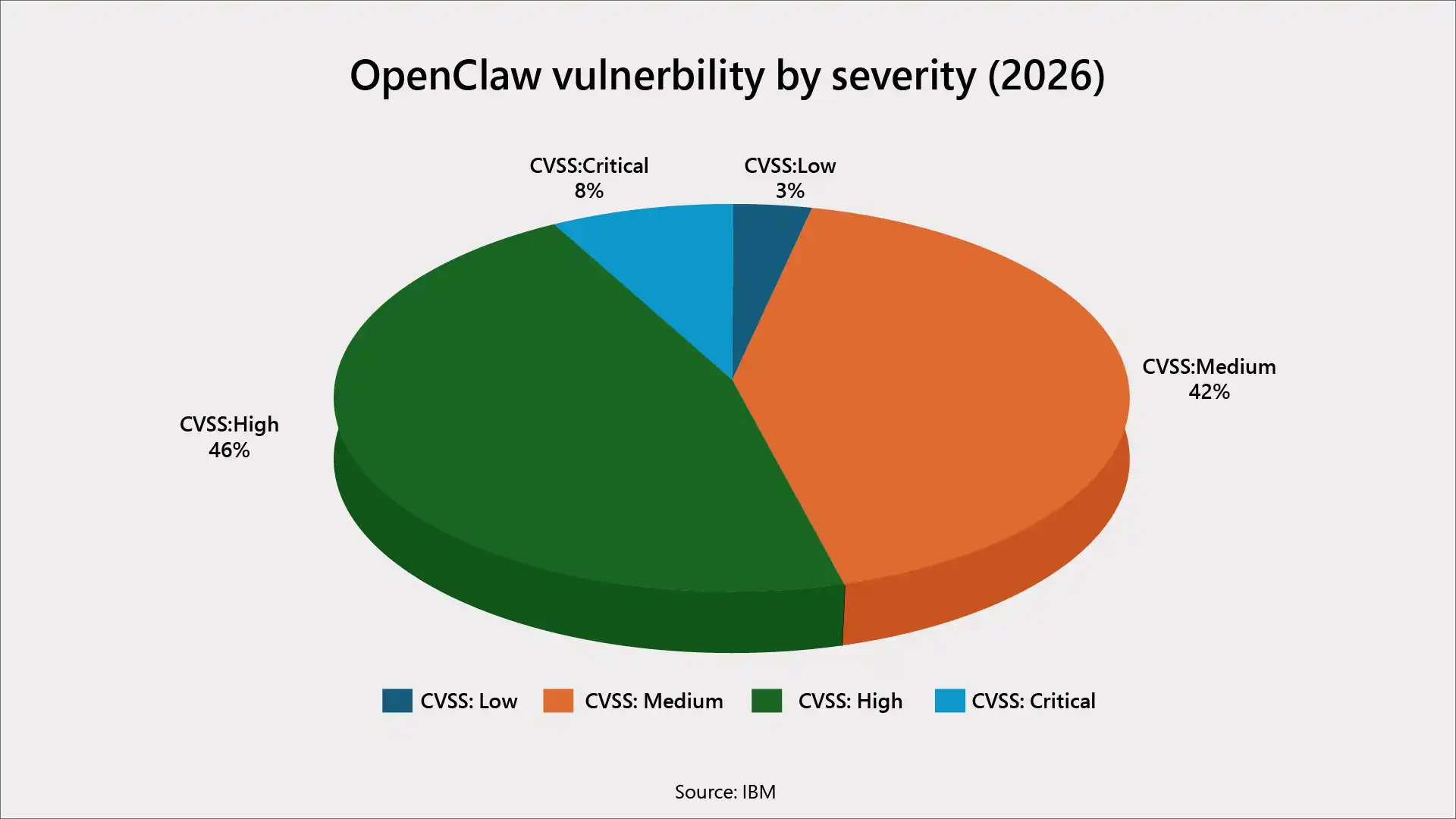
Breaking Down the CVSS Severity Distribution
The severity breakdown across OpenClaw's disclosures is not reassuring. With major weaknesses falling in the High and Medium range, the risk is not concentrated in rare scenarios, it sits across the everyday attack surface. One critical flaw in an agentic system does not stay contained; it moves through the action chain and can escalate into a full breach within minutes.
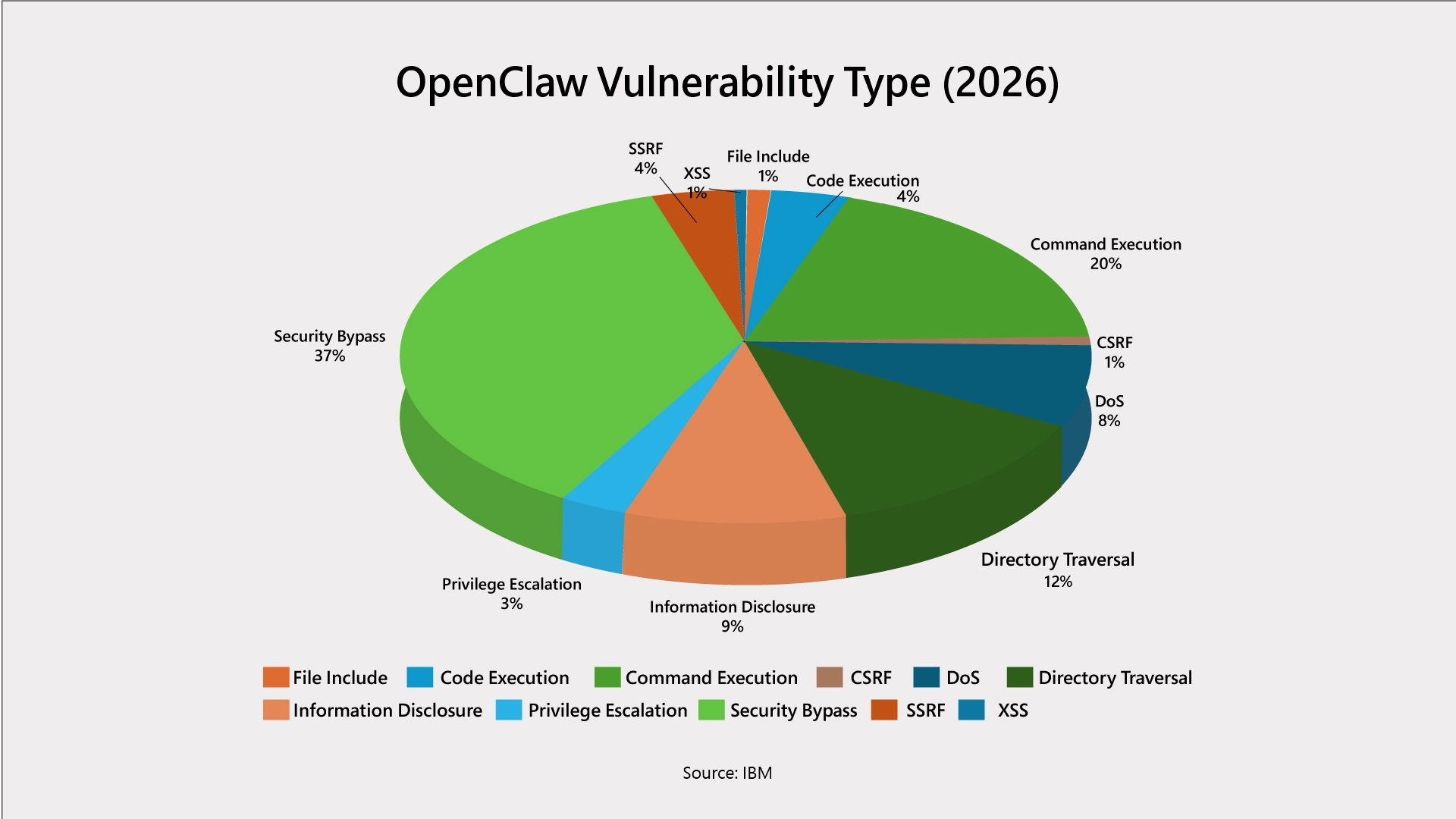
Where OpenClaw Actually Breaks
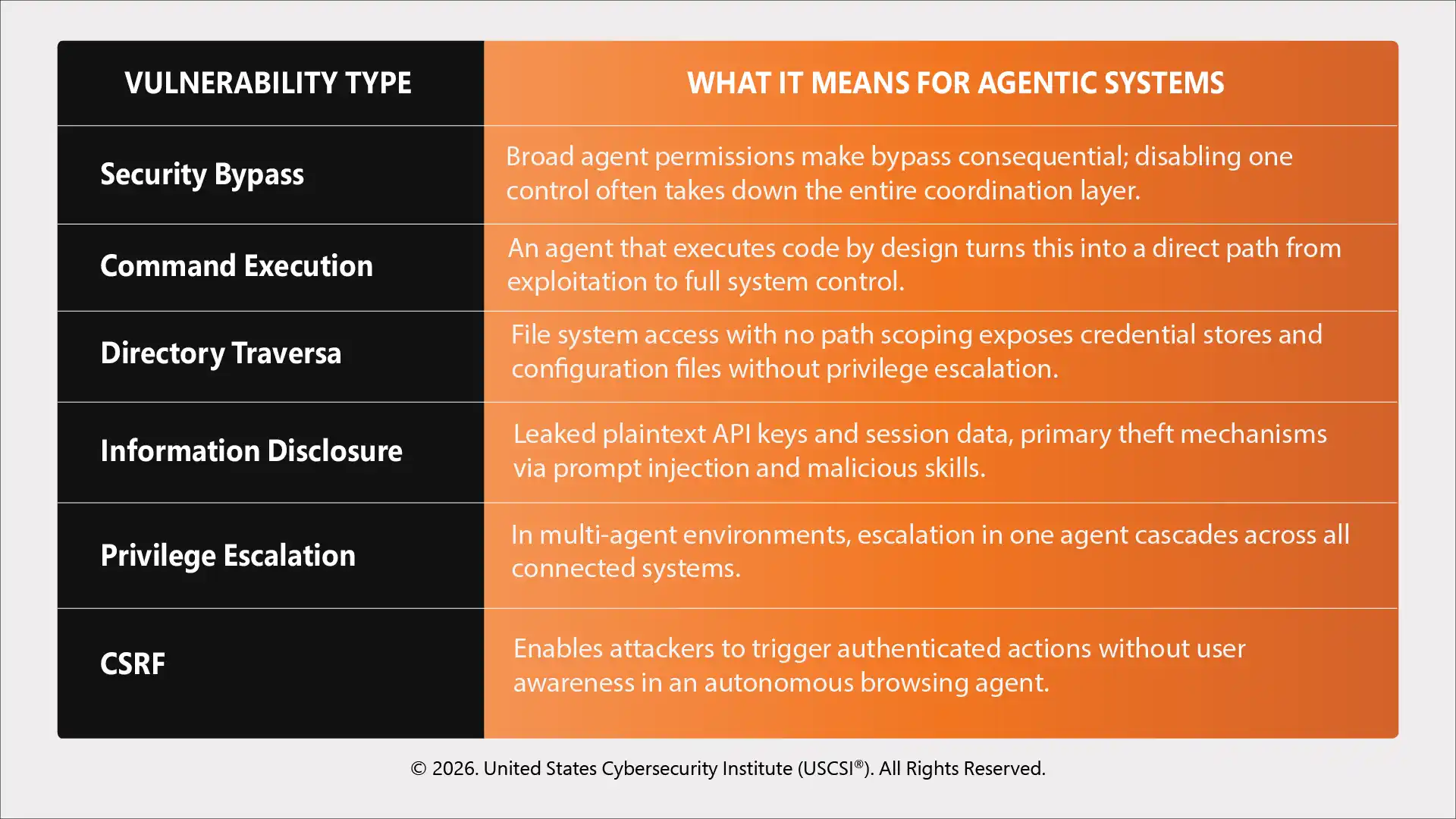
Severity tells you how dangerous a vulnerability is. Type tells you where the system breaks. OpenClaw's type distribution exposes structural problems patch management cannot fix alone.
Prompt Injection and Supply Chain: Two Vectors Enterprises Are Underestimating
The severity and type data establish the scale. These two attacks show how that risk is being actively exploited.
The ClawJacked Vulnerability
When OpenClaw cannot separate task data from embedded commands, it treats both as instructions. ClawJacked exploited exactly this; malicious websites hijacked locally running instances and silently exfiltrated data through the agent's own autonomy. The flaw was patched in version 2026.2.26, but only after active exploitation was demonstrated.
Prompt injection is not a niche concern. As USCSI® details in its analysis of prompt security in enterprise AI, 57% of employees use personal generative AI accounts for work, and 33% admit to entering sensitive information into unapproved AI tools in 2026, directly compounding this exposure.
The ClawHavoc Supply Chain Campaign
In early 2026, attackers uploaded over 1,100 malicious skills to ClawHub disguised as productivity tools and trading bots; several became the most-downloaded packages before detection, as per the hacker news 2026.
Once installed, a malicious skill operates inside the agent's trust boundary with full permissions. ClawHavoc proved the skill ecosystem is a supply chain surface, not a convenience feature.
Framework Architecture Is a Security Decision
Not every agentic framework carries the same risk profile. The architecture an organization selects directly determines the attack surface it inherits.
OpenClaw's broad ecosystem and integration depth are also the source of its security complexity. As USAII® notes in its OpenClaw vs. NanoClaw framework comparison, NanoClaw's Docker container-based isolation and minimal code architecture reduce that surface by design, a meaningful distinction for teams deploying agents in security-sensitive environments.
Framework selection is a security decision. For OpenClaw, that decision must come with a clear understanding of what its vulnerability profile demands in return.
What Security Teams Must Prioritize Right Now
The vulnerability profile OpenClaw presents maps directly to immediate action. Generic "patch and monitor" approaches are insufficient for agentic systems. Listed below are key strategies to prioritize.
- Expand Signal Sources Beyond CVE Feeds
Many OpenClaw vulnerabilities carry no CVE assignment. Track vendor advisories, research publications, and GitHub Security Advisories, not just CVE dashboards.
- Scope Agent Permissions to the Minimum Required
Broad permission grants are the root enabler. Provision agents with only the access their specific task demands.
- Treat the Skill Ecosystem as Supply Chain
ClawHavoc proved community repositories are active malware channels. Establish explicit allow lists and audit installed skills with the same rigor applied to third-party software.
- Implement Prompt Input Validation at Every Ingestion Point
Indirect prompt injection exploits the agent's inability to separate task data from embedded commands. Input sanitization and context isolation are foundational controls, not optional ones.
- Apply Behavioral Monitoring, Not Only Perimeter Defense
Agentic systems require action-level logging, what tools were invoked, in what sequence, with what inputs, to catch exploitation before exfiltration completes.
The Shift Security Teams Cannot Afford to Delay
OpenClaw is not one platform's problem; it is documented proof of what autonomous AI deployment looks like without the right security architecture. Attackers are already operating in the gap between discovery and formal disclosure.
Professionals securing agentic environments need cross-domain fluency across AI architecture, behavioral threat modeling, and enterprise controls, and USCSI® cybersecurity certifications are built to develop precisely that.
For cybersecurity professionals, the window to build agentic AI expertise is now; this is where specialization creates a career-defining advantage. For enterprises, the cost of treating agentic AI as an extension of existing controls will far exceed the cost of building the right architecture from the start.
Frequently Asked Questions
What role do AI SOC tools play in detecting agentic AI threats like those exposed by OpenClaw?
AI SOC tools must shift from signature-based detection to behavioral analytics, as agentic exploits produce no traditional attack signatures.
What should a Cloud Security Engineer prioritize when securing agentic AI deployments?
Least-privilege IAM policies, container isolation, egress filtering, and tool-invocation-level audit logging are the non-negotiables.
Is agentic AI security only relevant to organizations already using AI agents?
No, any organization piloting AI automation inherits structural risks the moment an agent gains execution rights or external access.